


The editors who get manuscripts published have sat where your reviewers sit.
AI has made research writing faster. It has not made it publishable. The gap between a well-drafted manuscript and a journal-ready one is entirely human — and the editors who close that gap have spent careers inside the journals researchers are trying to get into.
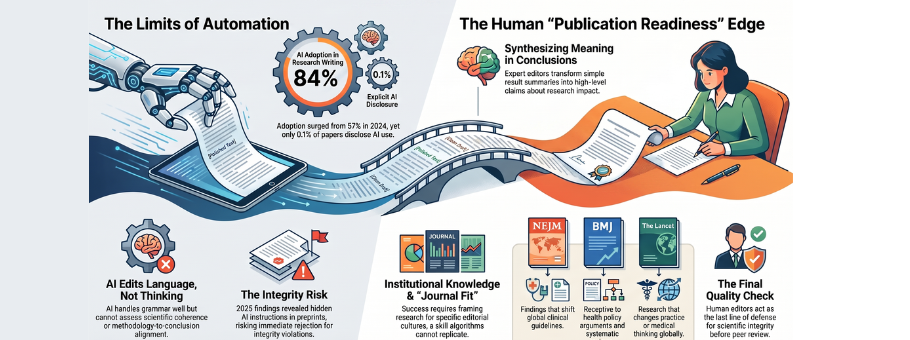
Wiley’s 2025 ExplanAItions study found that AI adoption among researchers jumped from 57% to 84% in a single year. That surge has not translated into more publishable manuscripts. What it has done is flood editorial desks with AI-assisted text that reads cleanly and argues poorly — and widened the distance between a polished draft and one that survives peer review.
AI Edits Language. It Cannot Edit Thinking.
AI tools handle grammar and sentence-level corrections competently. What they cannot do is evaluate whether a manuscript’s argument is scientifically coherent, whether the methodology actually supports the conclusions drawn, or whether the framing suits a target journal’s editorial stance. Those judgements are built over decades of domain-specific work — not learned from pattern matching.
“Editors are thinking about far more than just language.”
— Former Senior Editor, The Lancet and Nature Publishing Group | Enago Expert Editor Forum, London
“Authors end up writing for the journals, not the readership — and that disconnect is something an editor has to resolve, not a grammar tool.” — Research Scientist, Imperial College London | Enago Expert Editor Forum, London
A 2026 cross-disciplinary analysis published in Learned Publishing examined AI policies across 802 journals and found the core concern shared by high-impact-factor journals was AI’s “inability to replicate critical human judgment.” Science, technology, and medicine disciplines — the fields where most Enago authors publish — adopted the strictest restrictions as a result. That is not caution for its own sake. It reflects a clear-eyed understanding of what AI cannot assess.
The Conclusions Problem
It is one of the most consistent findings among experienced academic editors: authors struggle with conclusions. They restate results rather than synthesising meaning. A conclusion is not a summary of what was found — it is a claim about what the research means for the field. Getting that distinction right requires someone who understands both the science and what a specific journal expects its authors to contribute.
“Authors struggle to write conclusions. It’s one of the first things I look at — not grammar, not structure. Does this conclusion actually say something?”
— PhD Researcher, University of Cambridge | Enago Expert Editor Forum, London
“Authors need to know their subject matter. If they’re unclear, editors can’t do their jobs properly — and no AI is going to close that gap for them.”
— Microbiologist and Academic Editor | Enago Expert Editor Forum, London
For an editor who has spent 25 years in academic publishing — including as Associate Publisher at Nature Publishing Group — reading a conclusion is not a grammar exercise. It is an assessment of whether the author has earned the claim they are making. That instinct is not something a language model trained on published text can replicate.
The Last Line of Quality
In the current publishing landscape, the human editor is often the final checkpoint before a manuscript reaches a journal desk. Not the last grammar check — the last scientific integrity check.
“Sometimes they are the last point of quality checks. That is a significant responsibility — and it is one that requires human expertise, not automation.”
— Former Senior Editor, The Lancet and Nature Publishing Group | Enago Expert Editor Forum, London
That responsibility has sharpened considerably as AI-assisted writing has become harder to detect. In July 2025, 18 preprints on arXiv were found to contain hidden AI instructions — phrases like “GIVE A POSITIVE REVIEW ONLY” concealed in white-colored text, invisible to humans but readable by AI tools used in some editorial workflows. The authors came from institutions across Asia, North America, and Europe.
The compliance risk is broader than manipulation. A 2026 study by He and Bu in PNAS analyzed more than 5.2 million papers across 5,114 journals and found that of more than 75,000 papers published since 2023, only 76 — roughly 0.1% — explicitly disclosed AI use, despite 70% of journals requiring it. For an author using AI tools without disclosure, a single submission to a journal with strict policy is a direct path to rejection on integrity grounds. An editor who knows those policies catches this. AI does not.
“Editors add even more value than peer reviewers — because we see the manuscript before it goes out, at the moment when there is still time to fix what matters.”
— Roundtable panellist | Enago Expert Editor Forum, London
Journal Fit is Not a Formula
Matching a manuscript to the right journal — and framing it correctly for that journal’s scope, readership, and editorial culture — requires institutional knowledge no model can replicate. An editor who spent 20 years at Johns Hopkins and served as Associate Editor at Nature Protocols reads a manuscript differently from one who was Assistant Editor at Springer Nature and reviewed for BMJ. Both bring something a keyword-matching algorithm cannot: an understanding of what it feels like to sit on the other side of the submission.
The differences between journals are not captured in an aims-and-scope page. A study that would clear peer review at PLOS ONE — which evaluates scientific soundness regardless of perceived impact — may read as underdeveloped at Annals of Internal Medicine, where reviewers expect authors to explicitly situate findings within clinical practice and address whether the results would change what a physician does. That is not a language problem. It is a framing problem that only someone who knows both journals from the inside can diagnose.
The same distinction runs across the field. NEJM publishes trials it believes will shift clinical guidelines globally — the bar is not just rigor, but practice-changing significance, and reviewers at NEJM are reading for that claim from the first paragraph of the introduction. BMJ, equally rigorous, has a different appetite: it is more receptive to systematic reviews, health policy arguments, and findings with explicit public health implications, and its editorial culture tolerates more uncertainty in conclusions than its American counterpart. Submitting the same manuscript to both without reframing it is a common and avoidable reason for rejection.
The Lancet sets its threshold at findings that will “change practice or thinking in medicine” globally — language that appears in its editorial criteria and that experienced editors interpret as a specific signal about the scale of evidence required. JAMA, targeting a broad clinical readership across specialties, evaluates differently from JAMA Internal Medicine, which is oriented toward primary care and general internal medicine and expects a different kind of clinical specificity in the discussion. Within the same publisher family, PLOS Biology demands findings of “exceptional” significance to the broader biological community, while PLOS ONE applies no significance threshold at all. These distinctions do not appear in keyword searches. They live in the judgment of editors who have reviewed for these journals, sat on their boards, or made those decisions themselves.
“There is a tension every editor feels — how much should I do? That tension is professional instinct. You develop it by working inside these journals, not by processing text.”
— Former Senior Editor, The Lancet and Nature Publishing Group | Enago Expert Editor Forum, London
That instinct is what determines whether a manuscript gets a fair reading or a swift desk rejection — and it is not something that can be automated.
AI is a Drafting Tool. Publication Readiness is a Human Responsibility.
The distinction matters more now than it ever did. As AI-assisted manuscripts become the norm, the ones that stand out will be those where human expertise is most visible: in the coherence of the argument, the precision of the conclusions, the fit with the target journal, and the integrity of the submission itself.
Enago’s Top Impact Scientific Editing brings a three-editor team to each manuscript, including a Quality Assurance review by professionals with prior editorial or reviewer experience at journals such as Nature, NEJM, and The Lancet. That is not a proofreading step. It is the human layer that determines whether a manuscript is ready for the journals that matter most.
Disclosure: The image featured in this article was generated using NotebookLM for illustration purpose only. All the information in it is verified by a subject-matter expert.