




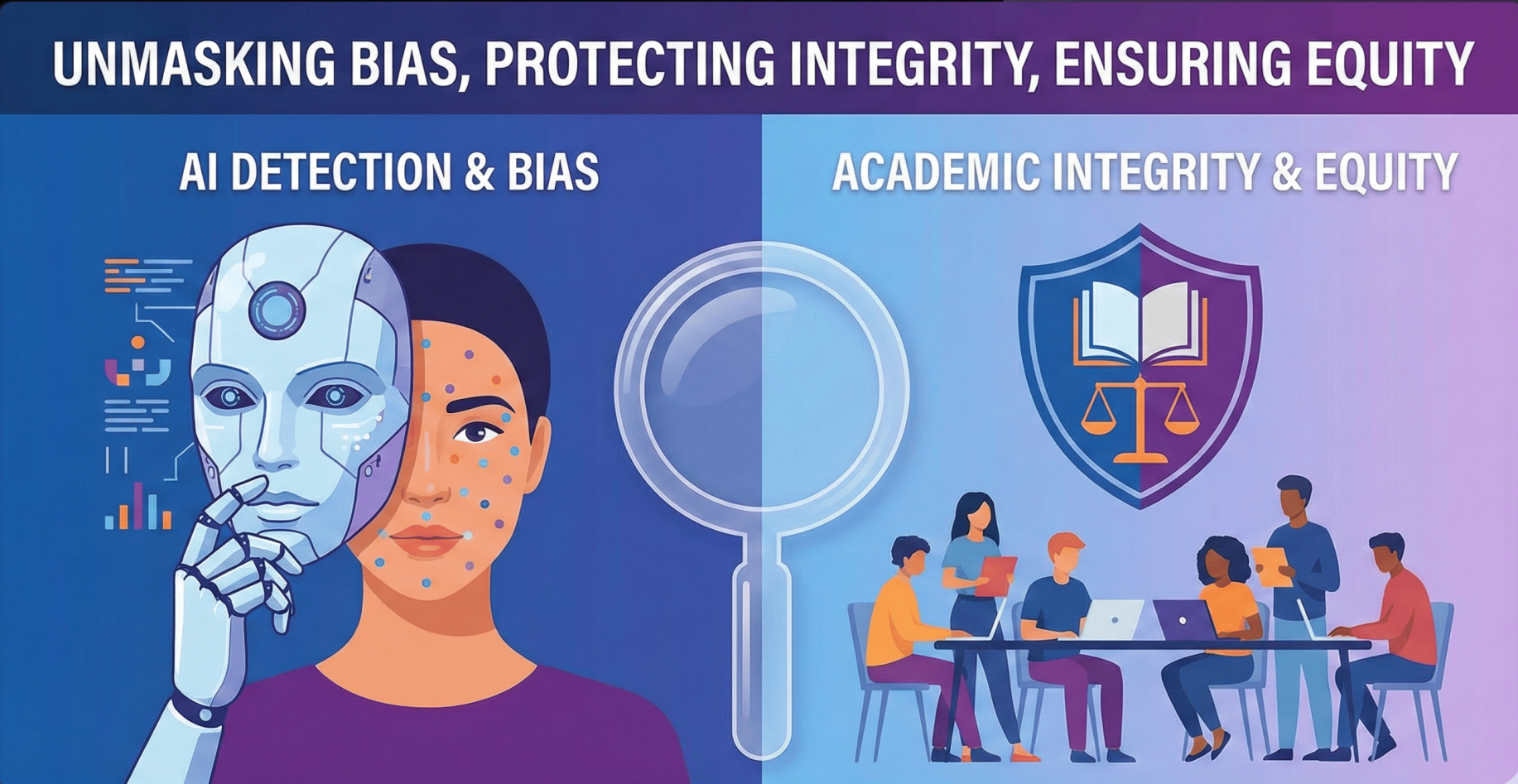
AI checking tools especially AI text detectors used to flag “AI-written” content are increasingly present in classrooms, research training programs, and editorial workflows. They are often introduced as a quick safeguard for integrity, yet the evidence base shows an uncomfortable reality: AI detectors can be both inaccurate and biased, particularly in high-stakes settings such as academic misconduct investigations, admissions, and scholarship decisions.
Bias in AI checking tools matters to researchers because the consequences are rarely “just technical.” A biased or unreliable flag can trigger reputational harm, delays to degree progress, strained mentor relationships, or unnecessary scrutiny during peer review. This article explains what bias looks like in AI detection, when it is most likely to appear, why it happens, and how institutions and researchers can reduce risk through responsible, evidence-based practices.
What “bias” means in AI checking tools (and why it differs from simple error)
In research and publishing contexts, “bias” in an AI checking tool typically refers to systematic performance differences across groups or writing conditions, not occasional mistakes. A detector can be “wrong” sometimes and still be fair, but it becomes biased when it reliably misclassifies certain writers more than others.
For AI text detectors, bias often shows up as higher false positive rates (human text incorrectly labeled as AI-generated) for specific populations or writing styles. This is particularly relevant for global academia, where multilingual scholars, early-career researchers, and interdisciplinary teams produce writing that may not match the detector’s assumptions about “typical” academic English.
Crucially, bias is not limited to language background. It can also arise from discipline conventions, genre constraints (e.g., Methods sections), and template-driven writing that legitimately creates repetitive or highly structured prose.
Why AI detectors are prone to bias in academic writing
Detectors do not “see” intent or process only surface patterns
Most AI text detectors infer likelihood of AI generation from features such as predictability, stylometry, or statistical signals associated with model outputs. However, academic writing itself often rewards exactly those features: clarity, consistency, cautious phrasing, and standardized structure.
When a detector treats “highly regular” prose as suspicious, it risks penalizing writers who are trained to write in a controlled, formulaic way, such as early-career researchers following departmental templates, or authors working in regulated fields with strict reporting norms.
Non-native English writing is a documented risk area
One widely cited study found that GPT detectors misclassified non-native English writing as AI-generated significantly more often than native English writing, raising serious equity concerns for international and multilingual scholars. The authors cautioned against using detectors in evaluative settings where such bias could cause harm.
In practical terms, this means that a scholar who writes in concise sentences, uses simpler vocabulary, or follows predictable syntax (common strategies in second-language academic writing) may appear “more AI-like” to a detector, even when the work is entirely original.
“Adversarial” reality makes fairness harder, not easier
Even when detectors perform reasonably on untouched AI outputs, real-world use often involves editing and rewriting, by humans, by AI, or by a mix of both. Multiple studies show that moderate paraphrasing or post-editing can substantially reduce detection performance, which creates a paradox: tools may miss sophisticated misuse while still flagging honest writers.
From an equity standpoint, this matters because access to advanced tools and sophisticated editing support is not evenly distributed. In other words, the people most likely to be “caught” may be those least resourced, not necessarily those most culpable.
When bias is most likely to appear: high-risk academic scenarios
Early drafts, short submissions, and partial excerpts
Short texts give detectors less data to analyze, increasing volatility. In academic life, this includes research proposals, short reflections, conference abstracts, scholarship essays, and cover letters. When a high-stakes decision is attached to a short text, the risk of harmful false positives rises.
Methods-heavy or compliance-heavy writing
Sections that require standard phrasing (IRB statements, ethical approvals, statistical reporting, limitations, data availability, author contributions) can look repetitive across papers. A detector that equates repetition with AI use may generate misleading flags.
Multilingual and global research environments
International programs, cross-border collaborations, and English-medium publishing pipelines naturally include a wide spectrum of proficiency and writing styles. Since bias against non-native English writing has been empirically documented, these environments require extra caution.
Academic misconduct processes
Even a “low” false positive rate can translate into a high number of investigations at scale. The concern here is not only accuracy; it is procedural justice whether the institution treats the detector output as evidence, or merely as a prompt for careful review.
How reliable are AI detectors today? What the evidence suggests
A key issue for administrators and educators is whether AI detection can be used as a robust decision tool. The most defensible interpretation of current evidence is that AI detector outputs are not reliable enough to function as proof, especially when outcomes are punitive.
Notably, OpenAI discontinued its own AI Text Classifier in 2023, citing a low rate of accuracy, an important signal given OpenAI’s proximity to the underlying model family being “detected.” More recent research continues to document limitations, particularly under real-world conditions such as edited text, mixed-authorship workflows, and evasion tactics.
For academic leaders, the takeaway is practical: a detection score should be treated as a fallible indicator, not a verdict.
How researchers can protect themselves without compromising ethical standards
Treat AI use as a disclosure and governance issue, not a secrecy issue
If AI tools were used for language polishing, outlining, or paraphrasing, the safest approach is to follow the target journal or institutional policy and disclose the tool, purpose, and boundaries of use where required. Enago Academy has also emphasized disclosure as a protective practice against misconduct allegations, particularly as guidance evolves.
Preserve process artifacts
Version history (tracked changes), dated drafts, lab notebooks, code repositories, and citation manager logs can help demonstrate genuine authorship and iterative development. This is especially useful when a detector produces an unexpected flag.
Use AI checking tools (if used at all) as learning aids, not compliance weapons
If a lab or course uses AI checking, it is more defensible to use outputs for coaching conversations: “Which sections feel generic?” “Where can argumentation become more specific?” This reduces harm while still promoting skill-building.
How universities and journals can reduce bias and build fair AI governance
- Prohibit punitive decisions based solely on an AI detector score. Detector results should never be treated as standalone evidence of misconduct.
- Validate tools locally before deployment. Performance should be tested on the institution’s real writing: multilingual samples, discipline-specific assignments, and authentic drafts.
- Establish an appeals process with clear evidentiary standards. If AI use is alleged, the process should specify what counts as evidence beyond a detector output.
- Train faculty and editors on limitations and bias. Without training, even a “responsible” tool can be used irresponsibly.
- Shift assessment and editorial checks toward provenance and reasoning. For example, requiring annotated bibliographies, oral defenses, lab meeting explanations, or methods justifications can evaluate understanding in ways detectors cannot.
Practical comparison: bias risks across common “AI checking” categories
| AI checking approach | What it tries to detect | Main bias risk in academia | Best-fit use case |
|---|---|---|---|
| AI text detection (“AI-written” score) | Likelihood of AI-generated phrasing | False positives for multilingual writers; false security against edited AI | Low-stakes triage only, paired with human review |
| Plagiarism detection (text overlap) | Similarity to existing sources | Can penalize legitimate boilerplate; may miss idea plagiarism | Best for citation hygiene and overlap checks |
| Authorship/process review (drafts, notes, oral explanation) | Evidence of research process and understanding | Depends on access to mentorship and documentation norms | Strongest for high-stakes decisions |
Moving forward: integrity without inequity
AI checking tools are often adopted to protect academic standards. Yet integrity systems fail when they disproportionately harm the very researchers they aim to support, including multilingual scholars and early-career writers navigating high-pressure environments. The current evidence base supports a careful approach: treat AI detection as imperfect, assume bias is possible, and design policies that prioritize transparency, due process, and learning.
For research groups and institutions building responsible workflows, Enago’s Responsible AI Movement provides guidance focused on transparent AI use, disclosure, and education in research publishing. Furthermore, when concerns about “AI-like” phrasing stem from overly generic language or unclear argumentation, professional manuscript editing can help improve clarity and discipline-specific voice, reducing avoidable misunderstandings while keeping authorship decisions with researchers and journals where they belong.
Ultimately, the most effective way to counter the limitations of “black-box” detection is to shift the focus from the final text to the research journey itself. While detectors guess at authorship based on style, the most reliable integrity measures validate the provenance of ideas.
To move beyond the uncertainty of stylistic flags, tools like Trinka DocuMark serve as the ultimate safeguard and assessment tool. Unlike standard detectors that search for “AI-like” patterns, DocuMark focuses on validating the actual writing and research process, providing an objective assessment of document integrity. By analyzing the evolution of a manuscript, it provides researchers and institutions with a robust way to demonstrate genuine authorship and process-driven quality effectively neutralizing the impact of algorithmic bias and ensuring that academic merit is judged on work, not just wording.

Frequently Asked Questions
What is bias in AI detection tools used in academia?▼
Bias in AI detection refers to systematic errors where certain groups or writing styles are more likely to be misclassified as AI-generated. In academia, this often affects multilingual scholars and structured academic writing.
Why do AI text detectors falsely flag human-written academic work?▼
AI text detectors analyze patterns like predictability and phrasing, which are common in academic writing. As a result, clear and formulaic scholarly writing can be incorrectly flagged as AI-generated.
Are AI detection tools biased against non-native English writers?▼
Research has shown that some AI detectors misclassify non-native English writing at higher rates. This creates equity concerns in global academic environments where multilingual scholars publish in English.
Can universities use AI detector scores as proof of misconduct?▼
No, AI detector scores should not be treated as standalone evidence of misconduct. Best practice is to use them only as preliminary indicators, followed by human review and due process.
How reliable are AI text detectors in real academic settings?▼
AI text detectors are not consistently reliable in real-world academic scenarios, especially when text is edited, paraphrased, or collaboratively written. Accuracy can drop significantly outside controlled testing conditions.
How can researchers protect themselves from false AI detection flags?▼
Researchers can reduce risk by documenting drafts, maintaining version histories, disclosing AI use when required, and preserving evidence of their research process to demonstrate authentic authorship.


