




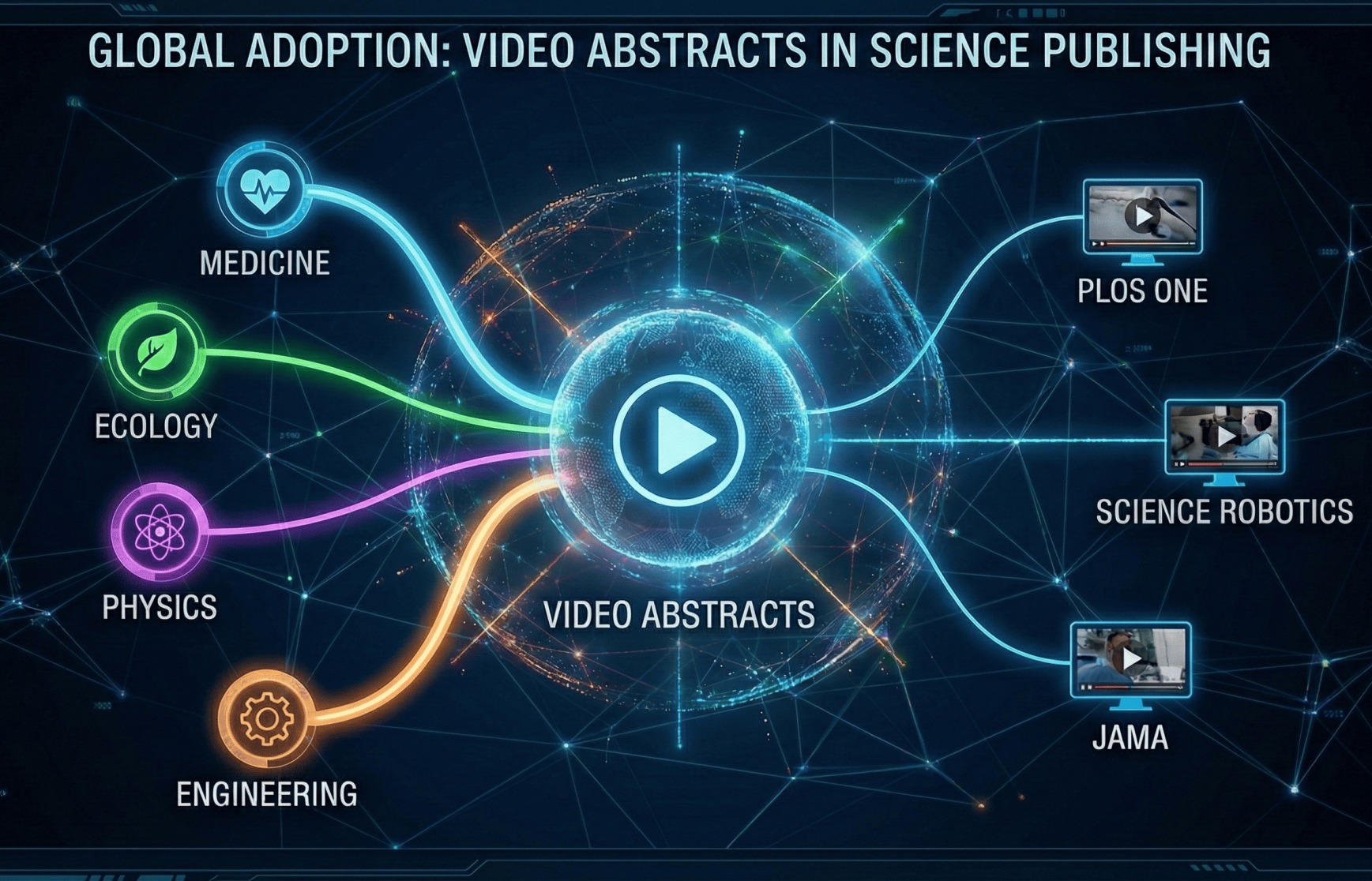
Multimedia summaries of research are no longer niche: publishers and authors are increasingly using short videos to explain findings, boost discoverability, and widen reach. A cross-disciplinary analysis found a sevenfold increase in video abstracts between 2010 and 2018, with growth concentrated in journals from major publishers; typical lengths fall between one and five minutes.
This trend matters for authors because some journals now invite or publish video abstracts alongside articles, and evidence suggests videos are associated with higher views, greater social attention, and small increases in citations. This article maps which disciplines and types of journals most commonly use or prioritize video abstracts, explains why publisher policies vary by field, shows practical examples, and offers guidance for authors deciding whether to invest in a video summary.
How Video Abstracts Differ from Other Formats
- Video abstract: Audiovisual summary using narration and motion
- Graphical abstract: Single visual optimized for quick scanning
- Lay summary: Plain-language text for non-specialists
Choose the format that best fits the audience and journal priorities.
Which Disciplines Use Video Abstracts Most
Medicine and Health Sciences
Medicine and clinical journals are among the earliest and most visible adopters. High-profile clinical journals produce publisher-created short videos (for example, the NEJM “Quick Take” series), and many specialty medical journals offer or encourage author-submitted video abstracts for research reports, reviews, and educational content.
This format works well where visual explanation of methods, clinical workflows, or patient impact is important, and where the audience includes clinicians who prefer concise media.
Life Sciences and Biomedical Research
Life sciences fields including molecular biology, cell biology, and neuroscience use video abstracts to show experimental setups, time-lapse data, microscopy, and animated mechanisms. Publishers and scientific societies often host videos on journal pages or YouTube channels to help translate technical findings for broader scientific audiences.
Major publishers’ branded video programs frequently list life sciences titles among those accepting video abstracts.
Environmental Science and Ecology
Environmental and ecological journals have invested in video abstracts to visually present fieldwork, geographic data, and model outputs. Discipline-specific studies show substantial uptake and diversity in formats, often combining still images, video footage, and data visualizations.
For researchers communicating policy-relevant findings, video abstracts can make messages accessible to policymakers and stakeholders beyond academia.
Physical Sciences, Engineering, and Materials
Physics, materials science, and engineering journals increasingly publish video abstracts to visualize experimental apparatus, simulations, and material behavior. Publisher support pages and specific journals explicitly list video abstracts as accepted supplementary media, indicating strong uptake where motion or three-dimensional structure clarifies results.
Social Sciences and Humanities (Select Journals)
Adoption in the social sciences and humanities is more selective. Some communication, education, and interdisciplinary journals proactively invite video abstracts or lay summaries, particularly where outreach and public engagement are central goals.
Journals aiming to reach policymakers, practitioners, or educators are most likely to accept videos. Generalist social-science journals vary widely, often prioritizing lay summaries or podcasts instead.
Why Some Journals and Fields Prioritize Video Abstracts
Audience and Application
Journals serving practitioners, interdisciplinary audiences, or public-facing communities prioritize video abstracts because video reaches non-specialists and speeds comprehension. Clinical practice journals and environmental policy outlets, in particular, benefit from succinct audiovisual explanations for downstream users such as clinicians, regulators, and NGOs.
Publisher Strategy and Resources
Large publishers often provide infrastructure, style guidance, and production assistance, lowering barriers for authors and increasing adoption across journal portfolios. Smaller or highly specialized journals may lack resources or maintain text-only workflows.
Publisher guidance from Wiley, Sage, and others typically includes length limits, captioning requirements, and file-format standards, signaling institutional support.
Disciplinary Norms and Demonstrability
Fields with inherently visual results such as microscopy, simulations, experimental setups, or field-based research derive disproportionate benefit from video. Where findings are primarily conceptual or theoretical, editors may prefer graphical abstracts or plain-language summaries instead.
Evidence on Impact: Views, Attention, and Citations
A cross-sectional study of New England Journal of Medicine research reports (2018-2020) found that articles accompanied by video abstracts (NEJM “Quick Take” videos) had:
- Higher article views
- Greater Altmetric Attention Scores
- A modest positive association with citations
Causation could not be established due to potential editorial selection bias. Overall, video abstracts correlate with increased visibility and social attention, particularly in high-profile journals. Authors should view video abstracts as a visibility and outreach tool, not a guaranteed citation booster.
How Journals Handle Video Abstracts (Policies and Examples)
Submission processes and technical requirements vary by publisher. Wiley and Sage provide explicit author guidance, including:
- Length limits (typically under 5 minutes)
- Captioning and accessibility recommendations
- Accepted file formats
Some journals produce videos in-house, while others accept author-created or vendor-produced files that meet style specifications. Authors should check journal instructions early to align content and technical standards.
Practical Guidance for Authors: When and How to Make a Video Abstract
When to Consider a Video Abstract
- When the paper includes visual material (e.g., microscopy, simulations, experimental videos)
- When the target audience includes clinicians, policymakers, educators, or practitioners
- When the journal or publisher explicitly encourages or supports video abstracts
Basic Production and Content Tips
- Keep videos concise (1–5 minutes)
- Present the research question and key finding early
- Show methods visually rather than listing them
- Include captions for accessibility and discoverability
Avoid reading the abstract verbatim. Instead, use a three-part narrative: context → key result → implication.
Checklist for Preparing a Video Abstract
- Confirm journal policy and technical specifications
- Draft a 60–90 second script focused on relevance
- Select visuals that clarify results
- Add captions and a DOI or clear citation on screen
- Maintain a formal, precise tone that complements the article
Common Mistakes to Avoid
- Reading the abstract verbatim
- Exceeding journal length limits
- Omitting captions
- Using copyrighted or unlicensed imagery
Always clear permissions and follow journal guidance on disclosures and authorship.
Conclusion
The shift toward multimedia summaries reflects a broader change in how scientific knowledge is consumed and shared. While the adoption of video abstracts is most pronounced in clinical medicine, life sciences, and environmental research, the benefits of increased visibility and audience engagement are universal. By translating static data into a dynamic narrative, a study becomes accessible to a global audience of clinicians, policymakers, and fellow researchers who increasingly rely on rapid, visual signals to find relevant literature.
Producing a high-quality video that balances technical accuracy with engaging storytelling requires a unique blend of scientific expertise and production skill. Enago’s Video Abstract services bridge this gap by transforming complex manuscripts into professional, high-impact audiovisual summaries. Each video is crafted to meet specific journal requirements while ensuring the core scientific message remains precise and compelling. Entrusting the production to specialists allows authors to enhance their research impact and reach wider audiences without diverting focus from their next major project.

Frequently Asked Questions
Which academic disciplines use video abstracts the most?▼
Video abstracts are most commonly used in medicine, life sciences, environmental science, and engineering, where visual data, experiments, or fieldwork benefit from audiovisual explanation.
Are video abstracts common in medicine and clinical journals?▼
Yes, many clinical and medical journals actively publish or produce video abstracts, especially to help clinicians quickly understand research findings and practical implications.
Do video abstracts increase citations and article visibility?▼
Studies show video abstracts are associated with higher article views and social media attention, with modest positive correlations to citations, though they do not guarantee increased citation counts.
Are video abstracts accepted in social sciences and humanities journals?▼
Adoption in social sciences and humanities is selective, with interdisciplinary and public-facing journals more likely to accept video abstracts than theory-focused publications.
How long should a video abstract be for journal submission?▼
Most journals recommend keeping video abstracts between 1 and 5 minutes, with concise scripts that present the research question, key findings, and implications clearly.
When should researchers consider creating a video abstract?▼
Researchers should consider a video abstract when their study includes visual data, targets practitioners or policymakers, or when the journal explicitly encourages multimedia submissions.


