
The Indexing Hierarchy: Deciphering Scopus, Web of Science, and SCI/SCIE for Strategic Submission




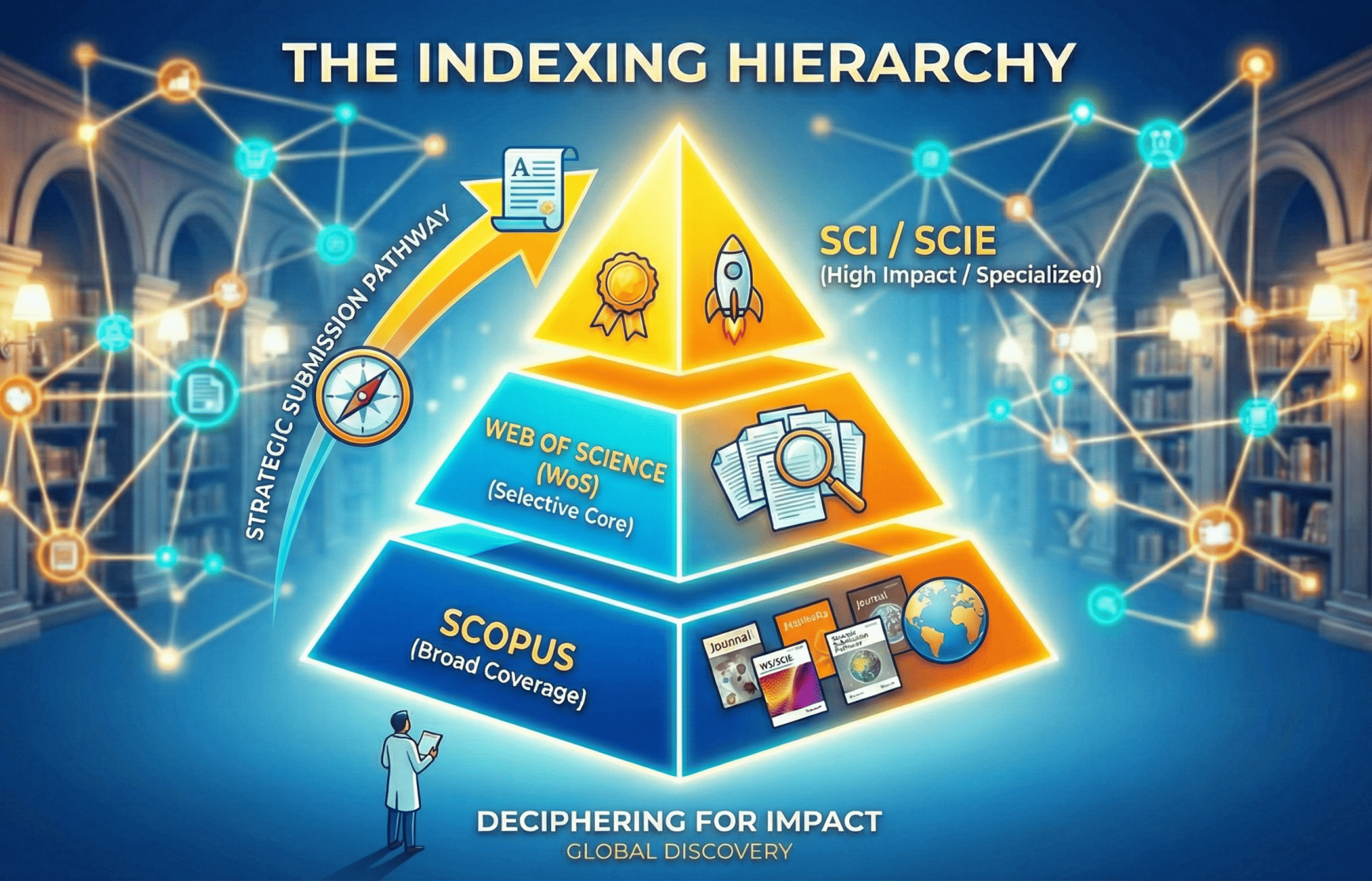
Choosing a journal often comes down to one practical question: Will the journal be indexed where evaluators actually look? For many universities and research organizations, that means Scopus indexing or Web of Science indexing (specifically the Web of Science Core Collection). In science-heavy evaluations, it often means SCI/SCIE indexing typically SCIE (Science Citation Index Expanded), which sits inside the Web of Science Core Collection.
Because these terms are often used interchangeably in lab meetings, committee discussions, and promotion reviews, it’s easy to assume they mean the same thing. They don’t. Misunderstanding the differences can lead to avoidable desk rejections, misaligned submissions, and unpleasant surprises during research assessment.
This guide explains what Scopus, Web of Science, and SCI/SCIE mean, why journal indexing matters, and how researchers can verify a journal’s indexing status before submitting. It also offers a practical way to choose the right indexing target based on discipline norms, output type (journals vs. conferences), and institutional requirements.
What “indexing” means and why it changes research visibility
In scholarly publishing, indexing means a journal’s articles (and their metadata) are included in a curated bibliographic database. Indexing directly affects:
- Discoverability in literature searches
- Citation tracking and author-level analytics
- Institutional reporting and research performance dashboards
It can also affect careers, because many institutions and funders use database inclusion as a proxy for editorial standards, publishing stability, and international visibility.
That said, indexing is not a universal quality label. Scopus and Web of Science use different selection models, criteria, and coverage priorities. As a result, the same legitimate peer-reviewed journal may be indexed in one database but not the other.
Scopus: broad coverage with a transparent selection framework
Scopus (Elsevier) is widely used for author profiles, citation analysis, and institutional benchmarking. Researchers often prefer Scopus for its breadth: it covers a large volume of journals, conference proceedings, and books across many disciplines, supporting cross-disciplinary discovery.
For journal evaluation, Scopus uses an independent Content Selection & Advisory Board (CSAB) and publishes clear expectations for eligibility and review. Scopus notes that journals should meet technical requirements such as peer review, a registered ISSN, publishing regularity, English titles/abstracts for international discovery, and a visible ethics/malpractice statement. After technical checks, titles are reviewed across criteria such as journal policy, content quality, journal standing, publishing regularity, and online accessibility.
Scopus also describes ongoing monitoring and re-evaluation, including flags for publication concerns or unusual performance patterns, which can lead to discontinuation of forward indexing even after acceptance.
When Scopus may be the better fit: Scopus can be especially useful when you need broad coverage across applied and interdisciplinary research, and when conference literature is central to your field (common in parts of engineering and computer science).
Web of Science Core Collection: selective editorial curation with defined indexes
Web of Science Core Collection (WoS CC) is curated by Clarivate and is frequently used in tenure/promotion workflows, institutional evaluations, and research analytics. A key differentiator is its emphasis on in-house editorial evaluation. Clarivate describes a set of 28 criteria, divided into quality criteria (editorial standards and best practices) and impact criteria (citation activity as a primary indicator).
Importantly, WoS CC is not a single list. It includes multiple indexes covering journals, conference proceedings, and books. Clarivate documentation describes indexes such as Science Citation Index Expanded (SCIE), Social Sciences Citation Index (SSCI), Arts & Humanities Citation Index (A&HCI), conference proceedings indexes (CPCI), and book citation indexes (BKCI).
When Web of Science may be the better fit: WoS CC is often the priority when institutional policies explicitly require Web of Science indexed journals, or when discipline norms strongly emphasize WoS CC coverage and Journal Citation Reports alignment.
SCI vs. SCIE: what researchers usually mean (and why wording matters)
Many researchers say “SCI indexed” as shorthand for “Web of Science indexed.” But the precise meaning is narrower.
Historically, SCI refers to the Science Citation Index. In most current evaluation contexts, the relevant index is Science Citation Index Expanded (SCIE) within Web of Science Core Collection. SCIE is a Clarivate-owned citation index that originates from Eugene Garfield’s work and has long-running coverage. Clarivate presents SCIE as a curated index of actively publishing science journals with extensive metadata and long coverage depth.
Why this distinction matters in real life:
A journal can appear in Web of Science Core Collection but not in SCIE (it may be indexed elsewhere within WoS CC). If a university policy explicitly requires SCIE (or “SCI-expanded”), treating any WoS listing as equivalent can create compliance issues during evaluation.
How selection and evaluation differ: Scopus vs. WoS vs. SCIE
Both ecosystems aim to curate reliable scholarly content, but their emphasis differs:
- Scopus: Highlights independent review via the CSAB and publishes structured technical and quality criteria, including ethics visibility and publishing regularity.
- Web of Science Core Collection: Emphasizes in-house editorial selection using 28 criteria split into quality and impact dimensions, with staged evaluation.
- SCIE: Not a separate database, but a specific WoS CC index focused on science journals, positioned by Clarivate as carefully curated and richly indexed for citation-network analysis.
A practical takeaway: Indexing outcomes can differ for newer journals, niche disciplines, and regionally important titles. Treat indexing as something you verify with evidence, not something you assume based on a journal’s marketing claims.
What to check before submission (and common mistakes to avoid)
A common mistake is relying on informal claims like “this journal is SCI” or “this conference is Scopus.” Journal websites may show outdated badges, ambiguous wording, or references to unrelated products (for example, “ResearcherID,” “CiteScore,” or general “impact” language) that do not confirm indexing status.
Before submission, verify:
- Which database is required by your institution, funder, or program (Scopus vs. WoS CC vs. specifically SCIE/SSCI).
- Whether the journal is currently indexed (not just “submitted,” “under evaluation,” or “indexed in the past”).
- Which index within WoS CC covers the journal, if your requirement is index-specific (e.g., SCIE vs. SSCI).
- Whether indexing is active and stable, especially if the journal has frequent special issues, rapid scope shifts, or confusing publisher changes.
Also separate indexing from metrics. For example, the Journal Impact Factor is tied to Clarivate’s Journal Citation Reports ecosystem, but many evaluation policies specify indexing requirements with or without metrics. Clarivate has also expanded Journal Citation Reports coverage over time, which is another reason to read current institutional rules carefully rather than relying on older assumptions.
A practical decision frame: which target makes sense?
A practical way to choose the “best” indexing target is to start with (1) assessment rules and (2) output type.
If your department’s promotion rules specify Web of Science Core Collection, a Scopus-only journal may still be a weak strategic choice even if it is well-run and peer-reviewed. Conversely, in disciplines where conference proceedings are a major scholarly output, Scopus’s conference coverage can be a meaningful advantage for visibility and citation tracking.
Finally, when policies say “SCI,” confirm whether they mean SCIE specifically or are using “SCI” informally to mean “Web of Science.” That wording difference can determine whether the publication counts.
Conclusion: treat indexing as a verifiable requirement, not a label
Scopus, Web of Science Core Collection, and SCI/SCIE are closely related in everyday academic conversation, but they are not interchangeable. Scopus often supports broad discovery and analytics across multiple content types. Web of Science Core Collection is positioned as a selective, editor-curated citation database that contains multiple internal indexes. SCIE is a science-focused index within WoS CC and is often what institutions mean when they require “SCI/SCIE publications.”
The safest approach is simple: confirm the required database, verify the journal’s current indexing status using official sources, and document that evidence before you submit.
When you’re deciding between target journals or need to align your manuscript with indexing requirements Enago’s journal selection service can help shortlist journals across required databases (including Scopus, Web of Science, and SCI/SSCI) and reduce misalignment risk by matching scope, indexing, and submission constraints.

Frequently Asked Questions
Is Scopus the same as Web of Science?▼
No. Scopus and Web of Science are separate citation databases with different selection criteria, coverage policies, and evaluation frameworks.
What is the difference between SCI and SCIE?▼
SCI historically refers to Science Citation Index, while SCIE (Science Citation Index Expanded) is the current science-focused index within Web of Science Core Collection.
How can I check if a journal is indexed in Scopus or Web of Science?▼
You should verify indexing directly through the official Scopus Sources list or the Web of Science Master Journal List to confirm current and active coverage.
Is SCIE indexing mandatory for promotion?▼
It depends on institutional policy. Some universities specifically require SCIE-indexed journals, while others accept broader Web of Science Core Collection coverage.
Can a journal be indexed in Scopus but not in Web of Science?▼
Yes. A journal may be indexed in Scopus but not in Web of Science, or vice versa, because each database uses different evaluation and selection criteria.
Does indexing guarantee journal quality?▼
Indexing signals editorial standards and stability, but it does not guarantee quality. Researchers should also assess peer review practices, scope alignment, and reputation.


