



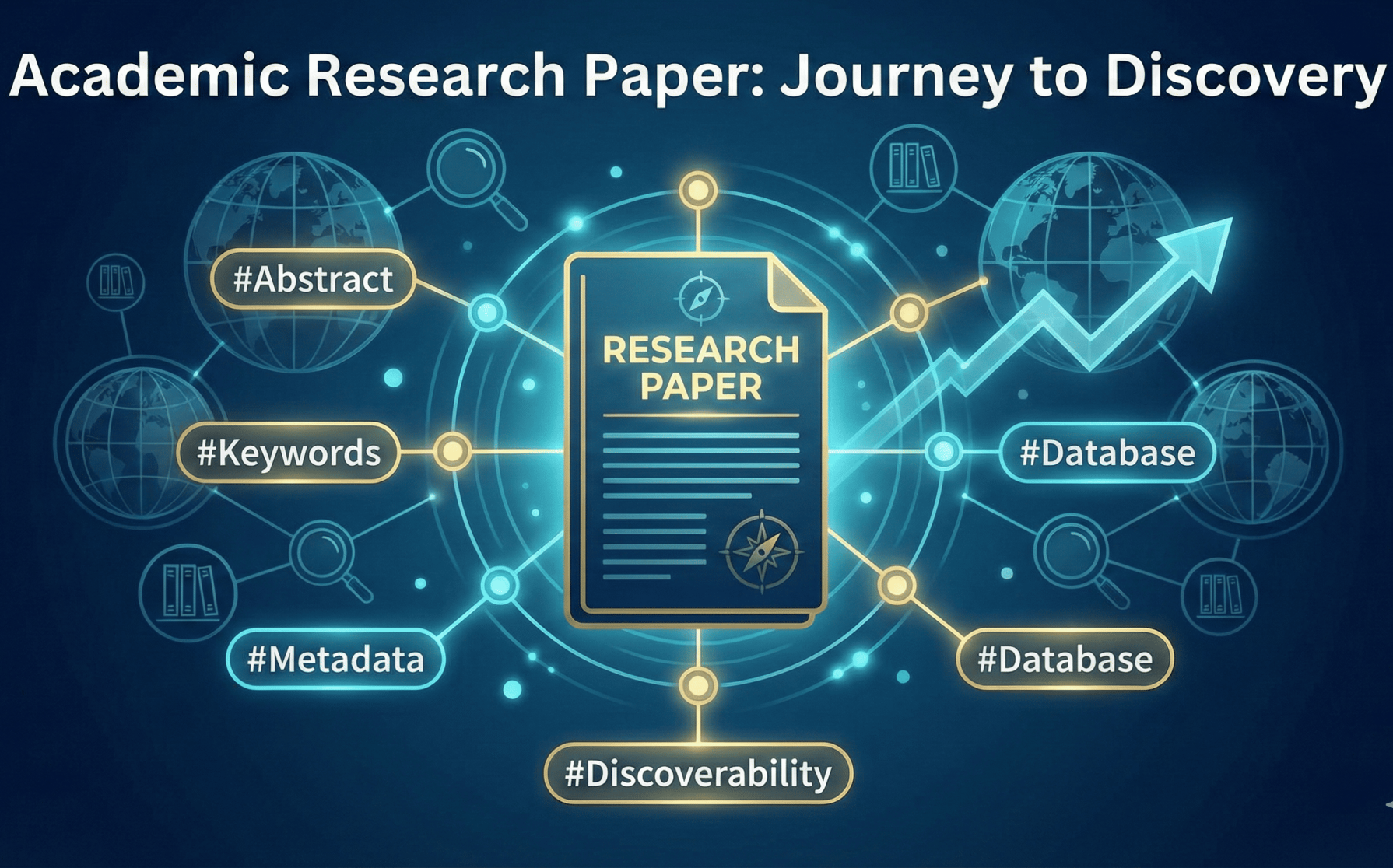
A well-written research manuscript can still go unread if researchers cannot find it. That gap is growing as discovery increasingly happens through academic search engines (such as Google Scholar), publisher platforms, library discovery layers, and metadata aggregators rather than through table-of-contents browsing.
In practice, SEO for a research manuscript means improving how accurately a paper is indexed, understood, and retrieved by these systems primarily through strong titles and abstracts, consistent terminology, and complete metadata. It does not mean stuffing keywords or writing for algorithms at the expense of scientific clarity. Publisher guidance explicitly warns against overdoing keyword repetition, while still encouraging the strategic use of a few key phrases in the abstract and title.
This article explains what manuscript SEO is, why it matters, how it works in scholarly discovery, and what practical steps help most across disciplines.
What SEO Means in Scholarly Publishing
In academic publishing, “SEO” is best understood as research discoverability optimization. The goal is to ensure that:
-
The paper is indexable (technically accessible to crawlers and discovery services),
-
Correctly classified (right bibliographic metadata),
-
Semantically clear (readers and machines can identify the topic, method, and contribution quickly).
This differs from commercial SEO in two important ways. First, scholarly search often relies heavily on bibliographic metadata (title, authors, publication date, journal, DOI, references) and structured tagging rather than marketing-style web content. Google Scholar, for example, recommends providing bibliographic information via supported meta tags and ensuring each article has a unique URL with an accessible abstract or full text.
Second, scholarly trust signals include persistent identifiers and citation links, which are maintained by infrastructures like Crossref and ORCID.
Why Research Manuscript SEO Matters (and When It Starts)
Research manuscript SEO starts earlier than many researchers expect. Choices made during writing especially in the title, abstract, and keywords shape how the work appears in academic search results, how it is interpreted by editors and peer reviewers scanning quickly, and how reliably it can be indexed after publication.
Furthermore, discoverability affects downstream outcomes that researchers and institutions care about: readership, citations, collaboration opportunities, and broader academic visibility. On the publisher side, Crossref emphasizes that richer metadata (beyond minimum DOI registration requirements) improves discoverability and helps connect research objects across the scholarly record.
How Scholarly Discovery Systems “Read” a Paper
Scholarly discovery typically combines three layers:
On-page Signals (What Readers See)
The title, abstract, headings, and visible terminology help both humans and machine parsers identify what the work is about. Editorial guidance from Nature Computational Science also highlights that clear titles and abstracts, with relevant keywords used naturally, improve reach and accessibility across multidisciplinary readerships.
Metadata Signals (What Machines Ingest)
Metadata is information deposited and exchanged through systems such as publisher platforms, repositories, and DOI registration agencies. Crossref participation reporting and best-practice discussions emphasize metadata elements such as abstracts, references, ORCID iDs, and affiliations (including ROR IDs) because these fields strengthen discovery and linking across systems.
Technical Crawl/Indexing Signals (What Determines Whether the Item Is Indexed at All)
If a paper is hosted on a lab website, institutional repository, or conference site, technical configuration can determine whether it is included in academic search. Google Scholar’s inclusion guidelines specify that each paper should have its own page (or PDF) and that the abstract or full text should be easily visible, with bibliographic meta tags configured when possible.
Title SEO: How to Write Searchable, Accurate Titles
A strong SEO-aware title remains a strong scientific title: precise, informative, and specific. The key difference is that it also anticipates how a target reader searches.
Publisher advice for discoverability suggests ensuring the main key phrase appears in the title and keeping the title descriptive and unambiguous; if a creative phrase is used, it can be paired with a more descriptive subtitle.
To apply this in real manuscripts, researchers can treat the title as a compact “index entry.” A practical approach is to include:
-
The core concept or phenomenon (topic),
-
The population/material/system (context),
-
The method or study type when it meaningfully differentiates the work.
Overly broad titles often underperform in academic search because they match too many unrelated queries. On the other hand, extremely niche phrasing can also reduce reach if the field uses multiple synonyms. When multiple labels exist (for example, a method name and a common-language term), using the more common phrase in the title and placing the alternate term early in the abstract often improves retrieval without making the title cumbersome.
Abstract SEO: Where Discoverability and Scientific Clarity Intersect
Abstracts matter because they often serve as the primary “landing text” that indexing systems display and parse. Nature Computational Science explicitly recommends writing abstracts as a miniature version of the paper problem context, method, key results, and implications while avoiding unnecessary jargon and including relevant keywords naturally to improve discoverability.
From a manuscript SEO perspective, the most impactful abstract choices are usually structural rather than gimmicky. Abstracts that state the central problem and specific contribution early help both readers and automated systems map the paper to relevant queries. Additionally, repeating 3-4 key descriptive phrases in a natural way can support discoverability, but publisher guidance cautions against “overplaying” repetition because search engines can detect abuse.
A useful way to stress-test an abstract is to ask: if only the title and first 2-3 sentences were visible, would the study still be findable and understandable to a researcher in the adjacent subfield?
Keywords: What They Do (and What They Cannot Fix)
Keywords act as controlled hints to indexing services and journal platforms. They can improve precision in retrieval when they reflect standard terminology in the field. However, keywords cannot rescue a manuscript whose title and abstract do not clearly represent the study.
The most effective keyword sets tend to mix:
-
Standard field terms
-
Specific technique or model names
-
Population/material descriptors
-
Common synonyms or alternate spellings where relevant
In addition, publisher guidance recommends focusing on a small set of key phrases in the abstract and selecting a set of keywords that includes both main phrases and additional supporting terms, including variants where multiple labels are commonly used.
A common mistake is treating keywords as an afterthought and selecting broad single-word terms that have little discriminative value. Another is selecting internal lab jargon that target readers would not actually search.
Metadata SEO: Why Persistent Identifiers and Complete Deposits Matter
For many researchers, “SEO” ends at the abstract. In scholarly publishing, however, metadata completeness is often the hidden driver of discoverability.
Crossref notes that minimum metadata is sufficient to register a DOI, but optional metadata fields are recommended to improve discoverability and persistent connections across the scholarly record. Crossref has also highlighted, in its updated participation reporting work, the practical importance of depositing abstracts, references, ORCID iDs, and affiliation information (including ROR identifiers) because these fields improve downstream linking and analysis.
Two identifiers are especially useful for discovery and attribution:
-
ORCID iD: ORCID provides a persistent digital identifier that distinguishes researchers and supports automatic links among professional activities across systems.
-
ROR ID: ROR is an open registry of research organizations intended to solve the affiliation identification use case and provide unique IDs plus metadata to support discovery and disambiguation.
While individual authors cannot always control what a publisher deposits, they can control whether these IDs are included during submission and whether affiliations are consistent and standardized.
Technical SEO for Hosted Manuscripts: What Repositories and Lab Sites Often Miss
Many discoverability failures happen before a reader ever sees the paper: the item is not indexed correctly, or it is misidentified.
Google Scholar’s inclusion documentation is unusually concrete about technical requirements. It specifies that each paper should be in its own HTML or PDF file, that abstracts should be visible and easy to find on click-through, and that bibliographic metadata should be provided using supported meta-tag schemas (such as Highwire Press tags). It also notes that PDFs are processed as if they had no meta tags unless linked from the corresponding HTML abstract page via tags such as citation_pdf_url.
This matters most for researchers who share published manuscripts on personal websites, lab pages, departmental pages, or nonstandard conference sites. In those cases, a simple, well-formed abstract page with correct meta tags can make the difference between being discoverable and being effectively invisible.
Common Research Manuscript SEO Mistakes That Reduce Discoverability
Several mistakes repeatedly cause indexing problems or poor retrieval:
-
Unclear titles that omit the core concept or rely only on clever phrasing, making the topic hard to match to academic search queries.
-
Abstracts that stay too general, delaying the concrete contribution until late, so systems and readers cannot quickly classify the work.
-
Keyword lists that are too broad (single words) or too narrow (local jargon), reducing precision and recall.
-
Inconsistent author names, affiliations, and missing ORCID iDs, increasing ambiguity across systems. ORCID specifically positions its identifier as a way to distinguish researchers and connect outputs reliably.
-
Repository pages that hide abstracts behind scripts or place multiple items on one page, which Google Scholar notes it cannot index effectively.
A Practical Workflow Before Submission
Researchers can treat manuscript SEO as a short pre-submission quality check:
-
Define 3–5 search phrases a target reader would likely type (including common synonyms).
-
Ensure the primary phrase appears in the title or very early in the abstract (without distorting meaning).
-
Use those phrases naturally in the abstract, focusing on clarity and avoiding unnatural repetition. Focus on a small number of phrases rather than overusing repetition.
-
Choose keywords that combine core terms, method terms, and variants used across subfields.
-
Confirm ORCID iDs and consistent affiliations (and include ROR IDs when journal systems support them).
-
If self-archiving, verify Google Scholar-friendly hosting (one paper per URL, visible abstract, supported meta tags).
This workflow stays aligned with research integrity because it improves representation of the work rather than manipulating impact signals.
Conclusion: Discoverability Is Part of Research Communication, Not an Afterthought
Effective manuscript SEO is not about “gaming” search engines; it is about ensuring your contributions are visible to the peers who need them most. By aligning your title, abstract, and metadata with the way the global research community searches, you bridge the gap between publication and impact.
If you find it challenging to condense complex findings into a searchable format, specialized support can help. Enago’s Abstract Writing Service ensures your study’s “front matter” is both scientifically rigorous and optimized for discovery. For those looking to extend their reach beyond traditional databases, our Scientific News Reports translate your findings into engaging formats that maximize research impact across broader academic and public circles.
Additionally, Trinka AI’s suite of writing tools enable researchers to create citation boosters and ResearchGate content that drive both citations and real-world impact.

Frequently Asked Questions
What is research manuscript SEO?▼
Research manuscript SEO is the practice of improving a paper’s discoverability in academic search engines through clear titles, structured abstracts, relevant keywords, and complete metadata.
How do I optimize my research paper for Google Scholar?▼
To optimize for Google Scholar, use a precise title, include key phrases early in the abstract, ensure proper bibliographic metadata, and host the paper on a page with a visible abstract and unique URL.
Do keywords really improve research paper discoverability?▼
Yes, but only when used strategically. Keywords help indexing systems classify your paper, especially when they reflect standard terminology and common search phrases in your field.
How important is metadata in academic SEO?▼
Metadata is critical for academic SEO because search engines rely on structured bibliographic data like DOI, author names, ORCID iDs, affiliations, and references to index and link research accurately.
Can keyword stuffing hurt my research manuscript SEO?▼
Yes. Overusing keywords can reduce clarity and may be flagged by search systems. Publishers recommend natural repetition of a few core phrases rather than excessive keyword stuffing.
When should I start optimizing my manuscript for discoverability?▼
Manuscript SEO should begin during writing, especially when crafting the title and abstract, since these elements most strongly influence indexing and academic search visibility.


