




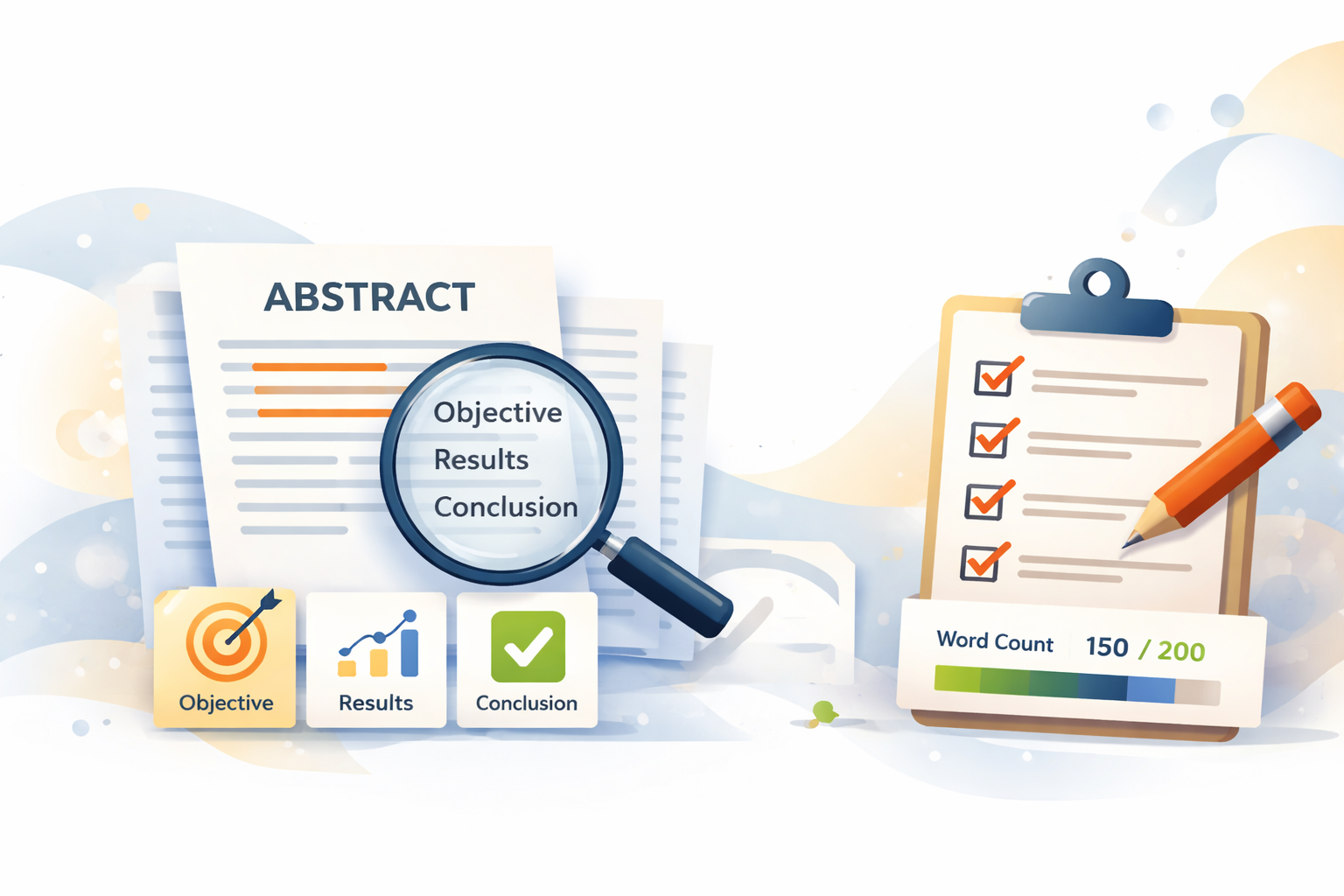
Most journals require abstracts that fit tight word limits commonly between about 150 and 350 words but the length and structure vary by discipline and publisher. Recent analyses show that abstract lengths have changed over time and that a median abstract in many journals falls near the mid-200s words. Concise presentation is a practical skill for authors who wish to avoid desk rejection or editorial requests for shortening.
What an Abstract Must Do
An abstract is a brief, standalone summary that signals the research question, approach, primary findings, and main conclusion so readers and indexing services can decide whether to read the full text. It functions as the paper’s elevator pitch and often determines whether editors send the manuscript for peer review.
Typical elements include:
- Problem statement or knowledge gap
- Objective
- Methods (brief)
- Principal results (with data when possible)
- Conclusion or implication
Why Word Limits Matter
Publishers impose abstract limits to:
- Standardize presentation
- Enhance discoverability
- Enable quick comparison across studies
Some high-profile journals require structured abstracts with explicit subheadings and strict word ceilings. For example, clinical journals in the JAMA Network typically allow up to 350 words for original research and systematic reviews. Adhering to these limits improves submission compliance and reduces the risk of administrative desk rejection.
How to Think About Reduction: Priorities and Trade-offs
When shortening an abstract, preserve these priorities in order:
- Objective(s): the research question or primary aim
- Key results: the main quantitative or qualitative findings
- Conclusion/implication: interpretation tied directly to the objective
Methods should be compact but credible (e.g., “randomized trial,” “multicenter cohort,” “systematic review of 12 RCTs”).
First elements to trim:
- Excess background
- Secondary outcomes
- Exploratory analyses
Practical Strategies to Shorten Without Losing Content
- Write the abstract last. Final results make prioritization easier.
- Use an IMRaD micro-structure. One–two sentences each for objective, methods, results, and conclusion.
- Lead with a tight objective sentence. Replace long background with a single contextual line.
- Prioritize numbers. Effect sizes and key statistics convey more in fewer words.
- Compress methods. Design + population + primary measure is usually sufficient.
- Remove filler and hedging. Use active voice and strong verbs.
- Limit abbreviations. Each abbreviation costs space and clarity.
- Combine clauses carefully. Economy without loss of meaning.
- Replace phrases with single words where meaning is unchanged.
- Collapse secondary findings into one phrase or remove them.
Step-by-Step Reduction Process (Apply Iteratively)
- Identify and underline the single-sentence objective
- Highlight results that directly answer the objective
- Remove background that does not support the objective
- Reduce methods to design + sample size + outcome
- Replace descriptive results with numeric statements
- Cut secondary or exploratory findings
- Eliminate filler, passive voice, and repetition
- Recount words and reassess priority alignment
- Get a fresh reader or editor to identify redundancy
- Ensure all abstract content appears in the manuscript body
Checklist: Wording and Formatting Tips
- Follow required structured abstract headings, if applicable
- Begin the results section with the most important finding
- Use compact numeric expressions (e.g., mean 12.3 ± 4.1 months)
- Avoid citations, tables, and figures unless allowed
- Ensure terminology matches the manuscript and keywords
- Check word count using the journal’s submission system
A Short Before – After Illustration
Original (220 words):
Background: The rapid increase in the prevalence of type 2 diabetes worldwide has become a major public health concern. Effective management of this condition is crucial in preventing complications such as cardiovascular disease and kidney failure. Recent studies have suggested that lifestyle interventions, particularly those involving dietary changes and physical activity, can significantly reduce the risk of developing type 2 diabetes in high-risk individuals.
Methods: This study was conducted over a 12-month period with a sample of 500 adults aged 45-65 years who were at high risk of type 2 diabetes. Participants were randomly assigned to one of two groups: a lifestyle intervention group (dietary counseling and exercise plan) or a control group receiving standard care. The primary endpoint was the incidence of diabetes, while secondary endpoints included weight loss, changes in blood pressure, and improvement in blood glucose levels.
Results: The lifestyle intervention group showed a 30% reduction in the incidence of type 2 diabetes compared to the control group (p<0.05). Secondary outcomes included a 5% reduction in body weight and a 10% improvement in blood glucose levels, but no significant change was observed in blood pressure.
Conclusion: This study supports the role of lifestyle interventions in reducing the incidence of type 2 diabetes in high-risk individuals. Further research is needed to explore long-term outcomes and the sustainability of these interventions.
Why it’s long:
- Extended background
- Detailed methods with multiple secondary endpoints
- Results listing several secondary outcomes
- Conclusion repeating significance and future directions
Reduced (100 words):
Aim: To evaluate the impact of a lifestyle intervention on the prevention of type 2 diabetes in high-risk individuals.
Design/Population: A 12-month randomized controlled trial with 500 adults aged 45-65 years at high risk for type 2 diabetes.
Principal Result: The lifestyle intervention group had a 30% reduction in the incidence of type 2 diabetes compared to the control group (p<0.05). Secondary outcomes showed a 5% reduction in body weight and a 10% improvement in blood glucose levels.
Conclusion: Lifestyle interventions can effectively reduce the incidence of type 2 diabetes in high-risk individuals, highlighting the importance of early preventative measures.
How it’s shortened without losing substance:
- One sentence for aim
- One sentence for design/population/sample size
- Two sentences for the principal result (with effect size/significance)
- One sentence for conclusion/implication
The reduced version preserves the study’s core message while removing peripheral detail.
Common Mistakes to Avoid
- Overloading background at the expense of results
- Omitting numeric outcomes
- Introducing information not found in the manuscript
- Overusing abbreviations or jargon
- Ignoring structured-abstract requirements
Conclusion
Shortening an abstract is an exercise in prioritization:
- Keep the objective explicit
- Report the principal result precisely
- State the primary implication clearly
Remove anything that does not serve these elements. Using the iterative reduction process and checklist above allows authors to save space without sacrificing substance. For those who prefer expert assistance, professional abstract-writing or editing support can ensure a polished, compliant abstract that preserves the study’s core message.

Frequently Asked Questions
What is the ideal length for a research abstract?▼
Most journals require 150-350 words, with the median around 200-250 words. Clinical journals like JAMA Network allow up to 350 words for original research, while others may have stricter limits depending on the discipline.
How do I cut my abstract from 300 to 150 words?▼
Start by removing extensive background, then compress methods to design plus sample size, prioritize quantitative results with exact numbers, eliminate secondary findings, and use active voice instead of passive constructions.
What should I never remove from an abstract?▼
Always keep your research objective, primary quantitative results with effect sizes or p-values, and the main conclusion that directly answers your objective. These three elements form the irreducible core of any abstract.
Can I use abbreviations to shorten my abstract?▼
Use abbreviations sparingly as each one requires definition and costs space. Only abbreviate terms that appear multiple times and are widely recognized in your field, like RCT for randomized controlled trial.
How do I know if my shortened abstract is still effective?▼
A good shortened abstract clearly states the objective in one sentence, presents the main result with numbers, and provides a direct conclusion. Ask a colleague unfamiliar with your work if they understand the study's purpose and outcome.
What's the fastest way to reduce abstract word count?▼
Delete the entire background section except one contextual sentence, reduce methods to just study design and sample size, keep only the primary result with statistics, and limit the conclusion to one sentence stating the main implication.


