




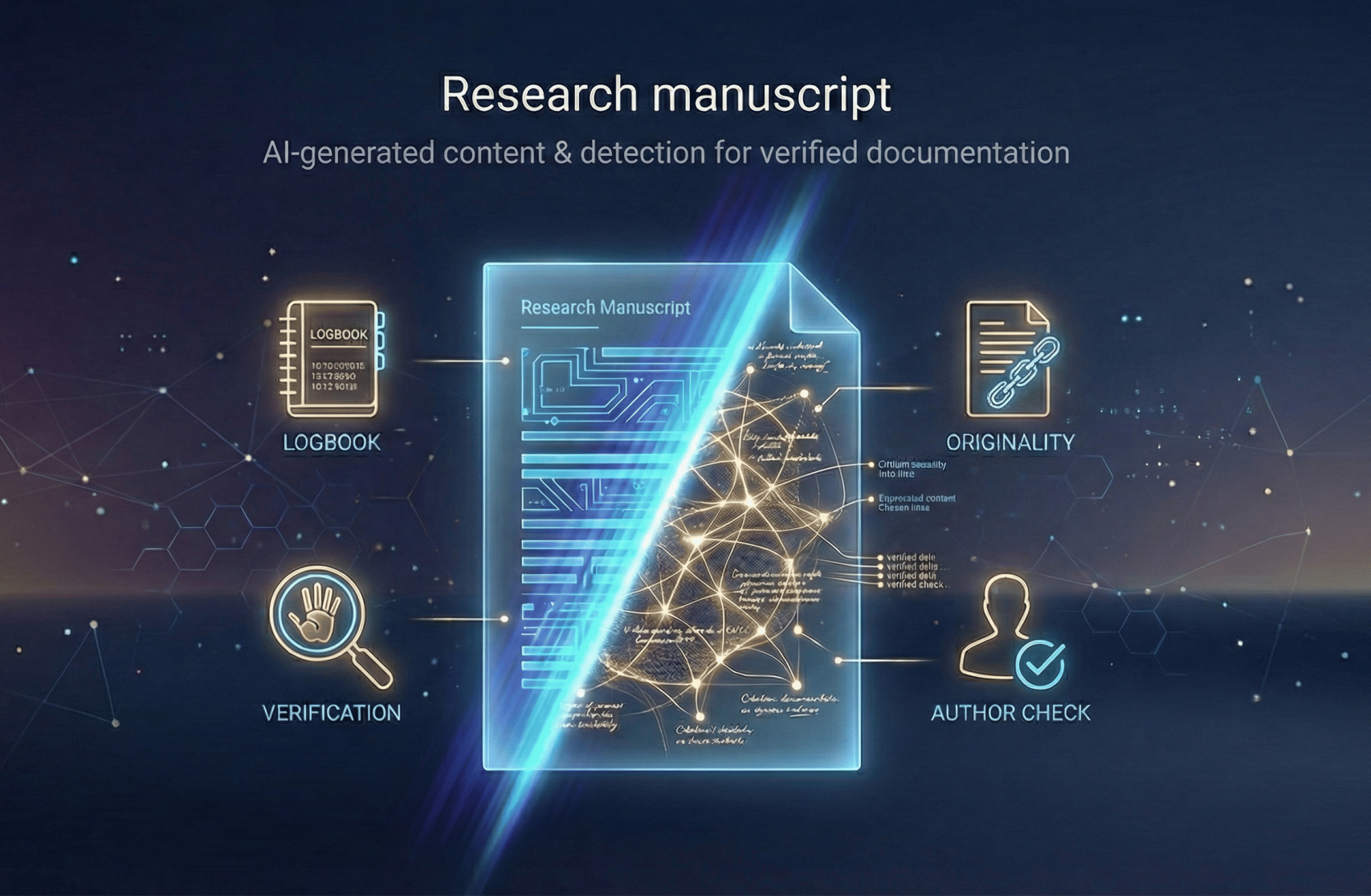
Universities and journals are tightening policies on generative AI, and many researchers now face a practical concern: a legitimate research manuscript that used AI for support (such as language polishing) may still be flagged by automated “AI detectors.” At the same time, trying to “beat” AI detection systems can cross ethical boundaries and raise serious research integrity and misconduct concerns especially if AI-generated text is presented as original scholarly work.
This article explains what AI detection in research papers typically measures, why false flags happen, and how researchers can reduce risk by using AI responsibly, documenting contributions transparently, and strengthening the human scholarly elements that detection tools cannot reliably imitate. It also highlights the most common mistakes, discipline-agnostic academic writing tips, and a step-by-step workflow suitable for most research fields.
What “AI Detection” Means in Scholarly Publishing (and Why It Is Controversial)
AI detection usually refers to software that estimates whether text was generated by a large language model (LLM). These tools often rely on statistical signals (for example, predictability of word choice) rather than evidence-based provenance (such as version history and documented drafting). As a result, outputs are probabilistic and can be unreliable when treated as proof.
This matters because a flagged research manuscript can lead to delayed peer review, additional author queries, or in the worst cases, allegations of misconduct. Importantly, detection tools can also produce false positives, meaning genuinely human-written text is mislabeled as AI-generated. Academic discussions have raised concerns about reliability and bias, particularly for authors who use standardized academic phrasing or who are non-native English writers.
A practical implication follows: the goal should not be “evasion.” The goal should be credible authorship, transparent disclosure where required, and reproducible academic writing practices that withstand editorial scrutiny even if a detector is used.
Why Researchers Get Flagged Even When They Did Nothing Wrong
Detection flags often stem from writing characteristics that are normal in academic manuscripts, not from misconduct. For example, methods sections frequently use repetitive structures, conventional phrasing, and consistent tone exactly the kind of uniformity detectors may interpret as “machine-like.”
In addition, heavy language polishing can unintentionally remove natural variation in sentence rhythm and phrasing that signals individual authorship. This becomes more likely when researchers (or tools) over-edit for fluency without preserving disciplinary nuance. Paraphrasing tools can also create risk: they may produce awkward synonym substitutions that appear algorithmic, even when the underlying ideas are original.
Finally, mismatches between claim strength and evidence specificity can trigger suspicion. Text that makes broad statements with few citations, vague methodological detail, or generic “research-sounding” phrasing may resemble AI output because LLMs often generalize when they lack grounded inputs.
Journal and Publisher Expectations: Disclosure Is Becoming the Norm
Many major stakeholders in scholarly publishing have clarified that AI tools cannot be credited as authors and that authors remain responsible for accuracy, originality, and proper attribution. For instance, COPE has discussed responsible use and reinforces that accountability rests with authors, not tools. Nature has also stated that LLMs do not meet authorship criteria and expects transparency about tool use when relevant. The ICMJE has added guidance addressing the use of AI in publication workflows, emphasizing author responsibility and disclosure expectations where applicable.
Because policies differ by journal and discipline, researchers benefit from checking three items before submission:
- The journal’s author instructions
- The publisher’s AI policy
- Any institutional AI-use rules connected to the research publication process
What Not to Do: “Bypassing Detection” Can Become Misconduct
Some online advice encourages authors to intentionally manipulate text to avoid detection (for example, “humanizer” tools, synonym spinning, or deliberate obfuscation). This approach is risky for three reasons.
First, it can reduce clarity and precision, increasing peer-review criticism. Second, it can look like intentional concealment, which is often treated more seriously than transparent, limited AI assistance. Third, it can introduce factual errors or citation distortions especially when automated rewriting changes technical meaning or shifts causal language.
A safer framing is this: avoid practices that intend to conceal. Instead, adopt academic writing strategies that demonstrate responsible authorship and make the manuscript defensible under editorial questions.
Responsible AI Use That Reduces Detection Risk While Improving Manuscript Quality
Define Acceptable AI Roles Early in the Writing Process
Researchers can reduce downstream confusion by deciding upfront whether AI will be used for brainstorming, outlining, language polishing, code assistance, or summarizing notes. This “scope control” is especially important for early-career researchers working in teams, where inconsistent practices can create authorship disputes later.
When AI is used, keep inputs grounded in your own materials (such as lab notes, protocols, and extracted results) rather than asking an LLM to “write something.” A practical rule is that AI output should rarely be accepted as final text without substantial human revision for disciplinary accuracy and argument structure in the research manuscript.
Preserve Human Scholarly Signals: Argumentation, Specificity, and Citation Discipline
Detectors tend to flag text that is fluent but generic. Human scholarship, by contrast, includes concrete decisions: why a variable was operationalized a certain way, why an exclusion criterion was chosen, why a sensitivity analysis was necessary, or how a limitation shapes interpretation. These are not merely stylistic choices they are intellectual contributions.
Manuscripts become more credible (and less “AI-like”) when they consistently do the following in connected prose:
- Define scope
- Specify assumptions
- Justify method choices
- Align claims with evidence strength
This also improves peer-review outcomes regardless of AI detection tools.
Avoid “Over-Smoothing” the Prose
Many researchers equate professionalism with uniformity. However, excessive uniformity can make writing feel templated. Academic writing still benefits from variation in sentence length, clear transitions, discipline-appropriate phrasing that reflects how researchers in that field argue, and an authentic author’s voice.
Instead of rewriting entire sections for “tone,” focus revisions on clarity, logic, and precision. If AI is used for grammar correction, treat it as a suggestion engine and keep author control over phrasing that carries technical meaning.
Use AI Transparently Where Policies Require It
If a journal requires disclosure of generative AI use, comply explicitly and keep the statement consistent with what was actually done. Editorial offices often care less about whether a tool was used and more about whether the use was responsible and documented.
When policies are unclear, a conservative approach is to document AI support internally (for lab or group records) and prepare to explain the workflow if queried.
Step-by-Step Workflow to Reduce AI Detection Problems in a Legitimate Way
- Check the target journal’s AI policy before drafting. Confirm whether disclosures are required and what counts as “AI-assisted writing.” Start with the journal’s author instructions, then check the publisher’s broader policy pages (COPE and ICMJE guidance can also help interpret expectations across journals).
- Draft the scientific core without AI first (where feasible). Methods, results, and key interpretation statements should originate from the research team’s own analysis and documentation. This anchors the manuscript in verifiable work and supports research integrity.
- If AI is used, constrain it to bounded tasks. Examples include reorganizing headings, generating alternative titles, improving readability of already-written paragraphs, or suggesting transition sentences. Avoid using prompts that generate entire sections without providing study-specific detail.
- Revise with an evidence-first lens. Ensure every major claim is supported by citations or data, and remove vague generalizations. This simultaneously strengthens scholarship and reduces the “generic” profile detectors often flag.
- Run a human-led consistency check before submission. Confirm terminology, abbreviations, statistical reporting, and citation accuracy. Detection tools do not validate truth, but editors and reviewers will during the research publication process.
- Prepare an AI-use statement if needed. Keep it factual: what tool was used, for what purpose, and confirmation that authors reviewed and take responsibility for content.
Common Mistakes That Increase Risk (and How to Fix Them)
A frequent mistake is letting AI rewrite a technical paragraph and then only skimming for grammar. This is where subtle meaning drift can occur especially in limitations, causal language, or descriptions of statistical significance. The fix is to verify technical meaning line-by-line after any automated rewrite.
Another mistake is using paraphrasing tools to “avoid similarity.” In scholarly contexts, the ethical solution is not to disguise sources but to synthesize them with correct citation. If similarity is high because a definition or guideline statement is standard, quotation and proper citation may be more appropriate than aggressive rewording.
Finally, inconsistent voice across sections can raise editorial concern. If one section reads like a highly polished template and another reads like a typical lab draft, the mismatch can trigger questions. A final harmonization pass focused on clarity and argument flow rather than cosmetic rewriting usually resolves this.
Practical Next Steps for Researchers Preparing a Submission
Researchers who want to reduce AI-detection problems should focus on what journals actually evaluate: accountability, transparency, and scientific rigor. That means using AI as a bounded assistant, not as a surrogate author; retaining clear evidence-to-claim alignment; and following journal policies on disclosure.
For teams facing tight deadlines or repeated language-related queries from reviewers, professional editing support can help improve clarity without introducing the risks associated with automated rewriting. Enago’s manuscript editing services are designed for academic writing quality and publication readiness (service overview: https://www.enago.com/manuscript-editing-services.htm). In addition, Trinka AI can support grammar and academic tone polishing with a focus on formal writing workflows (tool overview: https://www.trinka.ai). When used carefully, these options can help researchers strengthen readability while keeping authorship and technical meaning under human control.
The Gold Standard of Proof: Transparent Documentation
Beyond responsible AI use, the most effective way to address concerns about AI is to provide “ironclad” proof of the human effort behind the work. This is where tools like Trinka’s DocuMark change the game. Instead of relying on a software’s guess about whether text “looks” like AI, DocuMark allows researchers to record the entire drafting and editing process. By capturing the evolution of a manuscript from the initial raw data to the final polished prose authors create a verifiable audit trail. This documentation acts as a shield against false flags; if a journal ever questions the origin of a section, the author can produce a timestamped recording of their intellectual labor, proving that every breakthrough and every sentence was under human control.
Conclusion
Navigating the line between efficiency and ethics is the new reality of modern scholarship. The goal is no longer to bypass detection, but to build a workflow so transparent that questions of integrity never arise. By focusing on accountability and the intellectual “paper trail,” researchers can use technology to enhance their work without casting doubt on its authenticity.
As the academic community continues to adapt, staying informed is critical. To support this, Enago’s Responsible AI Movement provides a hub for researchers, editors, and publishers to discuss ethical standards and best practices for tool use. This initiative is dedicated to ensuring that as AI evolves, the human element of research originality, accountability, and truth remains the foundation of scholarly publishing. Engaging with these principles not only protects a single manuscript but helps preserve the collective trust in the scientific record.

Frequently Asked Questions
What does AI detection in research papers actually check?▼
AI detection tools analyze statistical patterns such as word predictability and sentence uniformity to estimate if text may be AI-generated. They do not prove authorship and can produce probabilistic, sometimes unreliable results.
Can a research paper be falsely flagged as AI-generated?▼
Yes. False positives happen when legitimate academic writing especially standardized methods sections or highly polished prose appears statistically predictable. Non-native English authors may also be disproportionately flagged.
Is it misconduct to use AI tools for writing a manuscript?▼
Using AI for limited support such as grammar correction or outlining is generally allowed if journal policies are followed. However, presenting AI-generated content as original scholarly work without disclosure can raise research integrity concerns.
How can I reduce the risk of AI detection flags before submission?▼
Focus on transparent AI use, document your drafting process, align claims with evidence, and strengthen discipline-specific argumentation. Human-driven revisions and accurate citations reduce the likelihood of generic, “AI-like” text.
Do journals require disclosure of AI use in research papers?▼
Many publishers and organizations such as COPE, Nature, and ICMJE now expect disclosure of generative AI use when relevant. Always check the journal’s author guidelines and publisher AI policy before submission.
Should I try to bypass AI detection tools?▼
No. Attempting to manipulate or ‘humanize’ text to evade detection can introduce errors and may be viewed as intentional concealment. Responsible use, transparency, and strong scholarly writing are the safest approaches.


