





Introduction
On June 23, 2025, Results in Engineering retracted a paper on green hydrogen production in Saudi Arabia, after editors found unexplained late-stage changes to the author list. Two days later, a paper on university development policy in the Gulf cited it anyway as ordinary supporting evidence, the same way as anything else.
Nobody was asleep at the wheel. A paper published on June 25 was drafted, submitted, reviewed, and accepted months before that retraction existed. By the time its source was discredited, the citing manuscript was past peer review, past the author’s last look at the reference list, and past any point where a correction was doable.
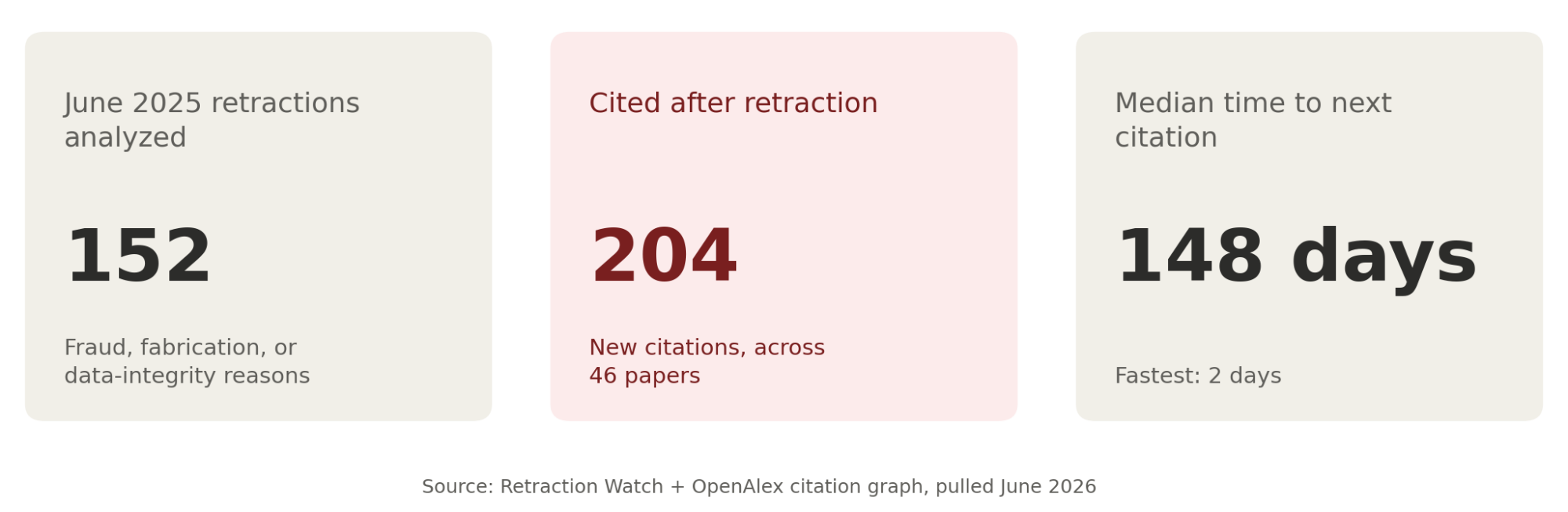
I pulled every retraction issued in June 2025 for fabricated data, manipulated images, faked peer review, and unreproducible results (n= 152) from the Retraction Watch Database. I then examined whether subsequent papers that cited them appeared to be aware of the retractions. Of the 151 papers cited at least once, three in ten (n= 46) picked up new citations after their retraction date: 204 citations in total. The citation volume does not decay after the retraction notices went live, it holds steady for the better part of a year (median of 148 days measured through the OpenAlex citation graph).
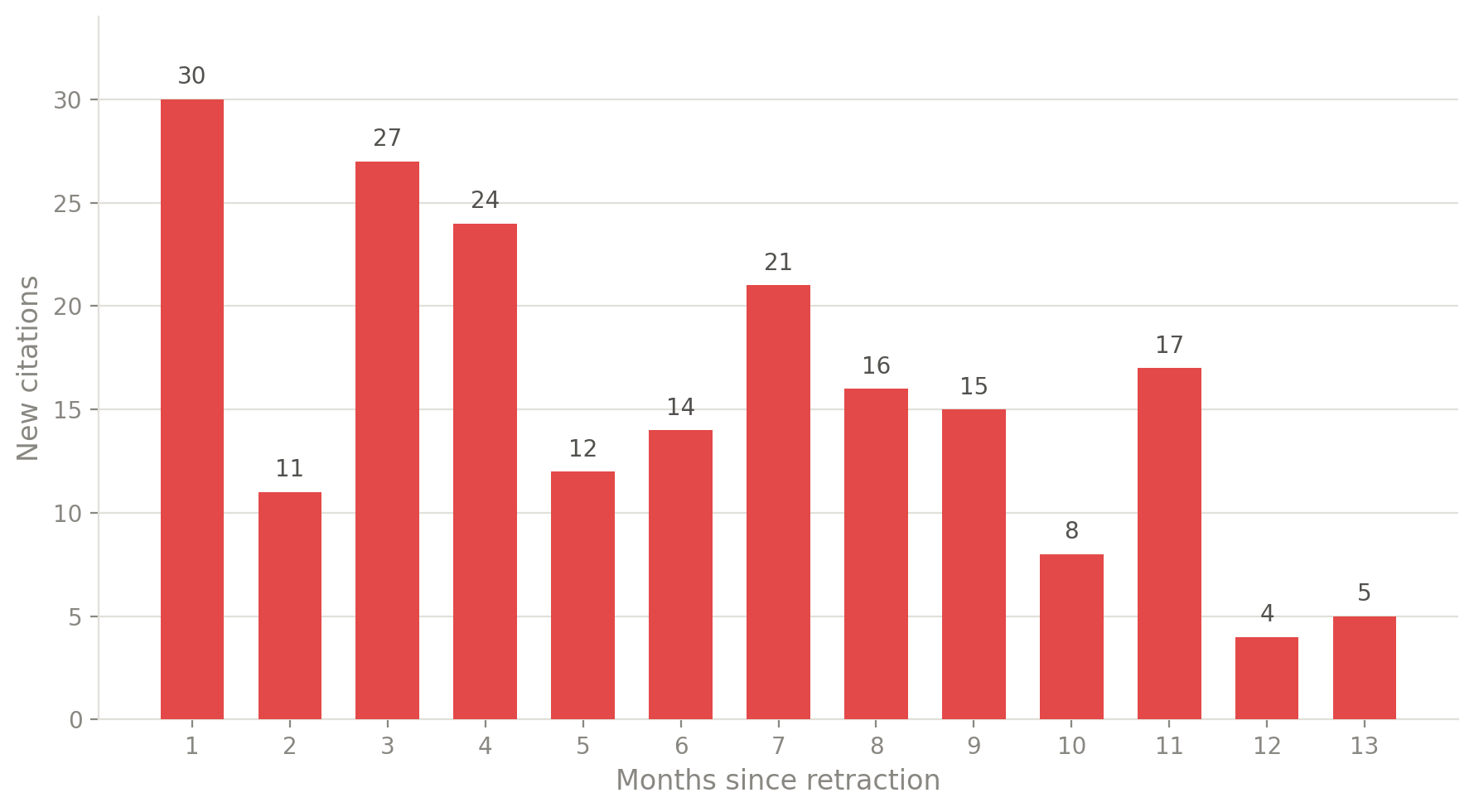 It would almost be a relief if this were a closed loop, bad papers citing bad papers in a quarantined corner of low-quality publishing. It isn’t, only two of those 204 citing papers were later retracted themselves. The contamination is reaching ordinary research: engineering reviews, clinical guidelines, drug-delivery papers, cancer biology, built partly on evidence that no longer exists.
Those are different claims, because the gap between writing a citation and seeing it in print is large. Andersen, Fonnes and Rosenberg’s systematic review of biomedical journals found median submission-to-publication times ranging from 70 to 558 days across 69 studies. Maggio and colleagues found a mean of 264 days from submission to PubMed in health professions education.
The 148-day median sits inside both ranges. So for a substantial share of these 204 citations, the retraction landed after the citing manuscript was written, and the author could not have known. This relocates the problem and the relocation is more damaging.
Why and How Retracted Citations Survive?
The pipeline’s two halves offer very different room for correction. Maggio and colleagues split it: a mean of 180.9 days from submission to acceptance (median 163), against 83.2 days from acceptance to appearing on PubMed (median 23). Andersen and colleagues found the asymmetry is not universal, acceptance-to-publication means ranged from 11 to 362 days but in majority of the journals most of the wait is review, not production.
Line that up against 148 days. For a typical paper, a retraction arriving 148 days before publication arrived during peer review: while the manuscript was under revision, in an editor’s hands, still fully editable. It did not arrive in the narrow production window at the end. It was visible, in principle, to at least three people who handled the paper afterwards: the author preparing a revision, the reviewer reading it, and the editor accepting it.
Once a manuscript enters production, removing a reference is not practically available: proof corrections are scoped to typesetting, and pulling a citation renumbers the reference list and alters the sentence that relied on it. That is a rewrite. If a retraction lands after acceptance, the author can ask for an editorial exception or pursue a corrigendum later. Neither is a workflow. So the genuinely blind stretch is narrow: the weeks between acceptance and print. The far larger stretch before it is not blind. It is unwatched.
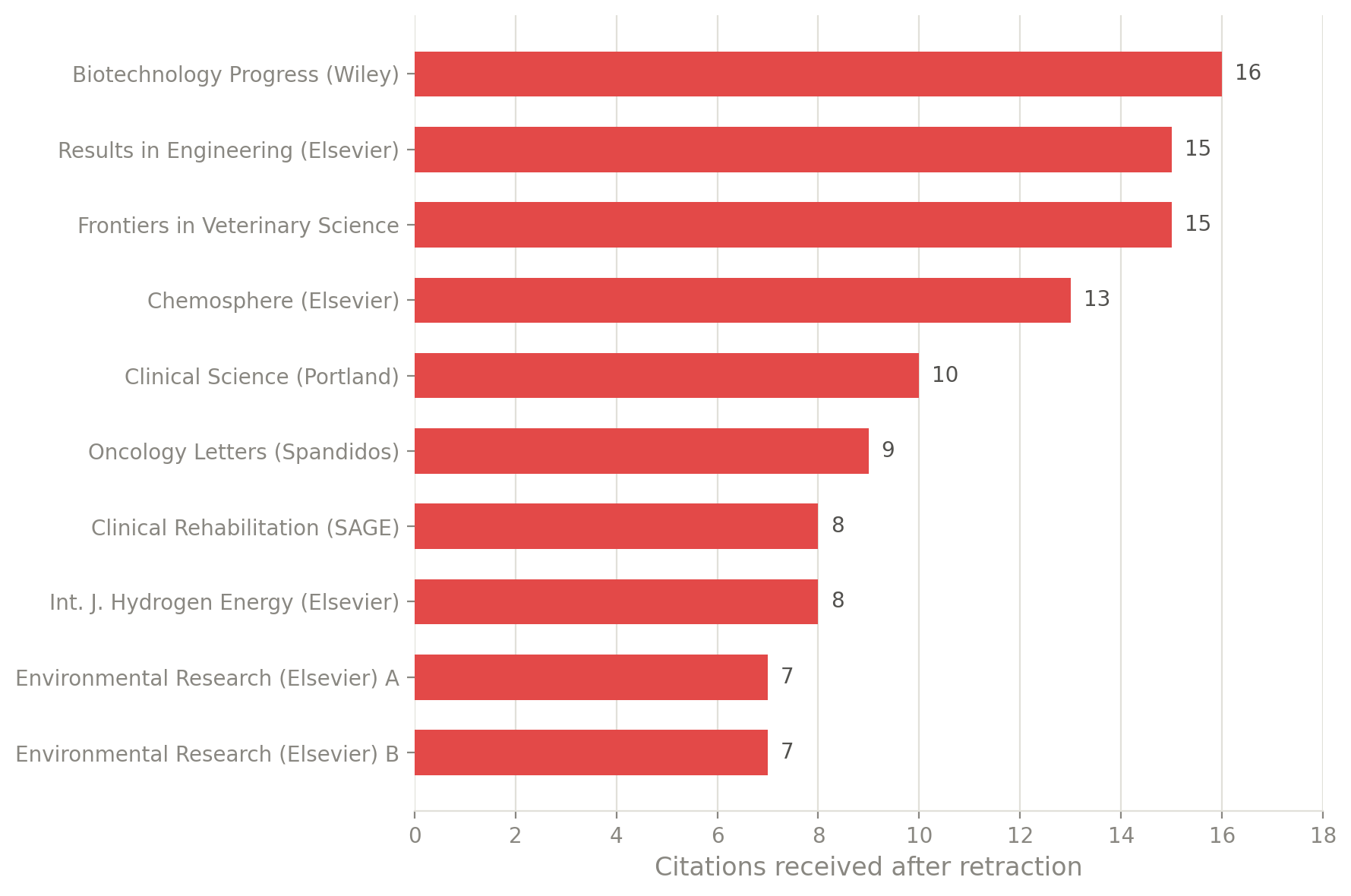
The citation graph shows retracted work keeps getting cited. I went back to 10 of the most heavily re-cited cases and checked: did the citing paper acknowledge the retraction anywhere a careful researcher would normally look. In every case, there was no corrigendum or other indication that the retraction was realized.
Two complications cut against a tidy version of this argument. Retraction indexing is unreliable: Schneider, Lee, Zheng and Salami built a union list of 49,924 publications flagged as retracted by at least one of Crossref, Retraction Watch, Scopus and Web of Science, and only 3% were flagged by all four. And the acknowledgment bar is already known to be low: Hsiao and Schneider found only 5.4% of post-retraction citations in PubMed Central acknowledged the retracted status of what they cited.
The Three Editorial Checkpoints Where Retraction Screening Should Occur
- At submission. A reference list is machine-readable the moment it reaches an editorial system, which already runs plagiarism and image-integrity checks. Screening against retraction data is no harder, and it catches the category with no excuse: sources already retracted before submission.
- At revision. The largest window and the least used. Reference lists get re-checked for formatting, never for whether the underlying work still stands.
- At acceptance, as a condition of it. The last moment a reference can change without a formal correction. A list clean at submission and no longer clean at acceptance, but this is the case nobody looks for.
After that the door closes, which argues for one narrow policy change: a retracted source found between acceptance and print should be among the few substantive amendments production is obliged to accept. It is the only correction in the process whose cost increases the longer it is delayed.
Retraction is a Notice. It is Not a Notification.
A retracting journal issues a notice, updates its page, sometimes applies a CrossMark watermark, reports to PubMed. The obligation is discharged. But the notice sits at a URL waiting for someone to come looking. Nothing reaches into the manuscripts in review queues right now that cite it. The data exists: Crossref acquired the Retraction Watch database in 2023, updates it every working day, and exposes it free through the REST API. What is missing is to point it at work in progress.
Part of the reason is structural: under open access, a publisher’s primary transaction with a paper is the article processing charge, which clears at acceptance. By the time a retraction happens, often years later, the publisher has been paid and the commercial relationship is over. That is not bad faith; it means the incentive to police the citation network afterwards is weak, exactly where it matters most. Every stakeholder has a defensible reason not to be the one who closes the loop, and that is how the loop stays open.
The Obligation Runs Backwards Too
Everything above concerns unpublished manuscripts. The larger neglected population is the papers already in the literature that cited the retracted work. Of my 204 post-retraction citations, only 2 citing papers were later retracted; the other 202 sit in the record unmarked, citing withdrawn evidence. And that is only the citations arriving after the retraction, there are so many more who have cited these before they were retracted.
What ought to happen is not the same as retracting the citing paper:
- The retracted paper’s publisher should hand its citing set to Crossref as a machine-readable relationship, so that tools reading a citing paper’s metadata surface the flag.
- Each citing paper’s publisher should notify its corresponding author once, automatically, when a cited source is withdrawn.
- The author should then request an editorial note or corrigendum recording that reference [n] has been retracted and what (if anything) it changes.
None of this implies that the citing work is invalid. Instead, it ensures the scholarly record carries a clear, visible indication that the cited source is no longer reliable, placed exactly where readers are most likely to encounter it. Rather than limiting that notice to the retracted paper itself, where few readers are likely to look. This approach brings the correction directly into the context in which the citation is being used.
The Fix isn’t Complicated. It’s Just Nobody’s Job.
The data needed to flag a citation to a retracted paper exists, free to query, updated daily. What is missing is the will to make it push forward into manuscripts in progress and backward into the papers that already cited the work.
The pipeline finding argues for something more specific than “check your references.” A check at drafting is structurally insufficient, because at drafting the retraction may not have happened yet. What the evidence argues for is continuous verification: re-screened at submission, at revision, at acceptance, and monitored afterwards. A check on the day you write a citation is a snapshot of a record that keeps moving.
Until then, retraction does half its job. It removes a paper from the record of what is considered true. It does almost nothing to remove it from the record of what is still cited as if it were.
Common Questions


