



Peer review is under strain. Journals are publishing more articles than at any point in history, qualified reviewers are harder to recruit, and editors are managing workloads designed for a smaller publishing ecosystem. A growing number of publishers are responding by partnering with third-party services to handle parts of the review process. What does the evidence say about how well this works?
 Why Journals Are Having This Conversation
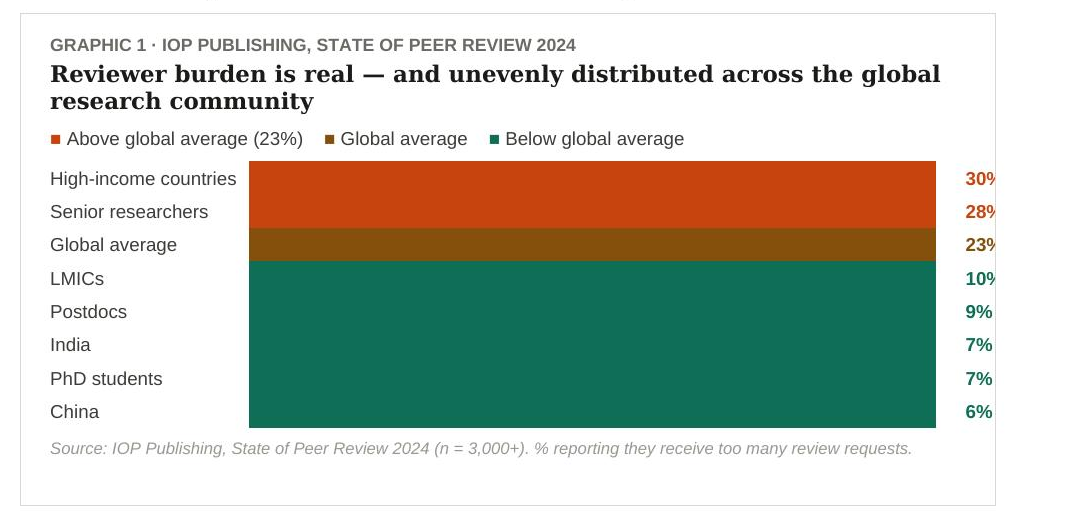
The capacity numbers explain why publishers are exploring new models. IOP Publishing’s State of Peer Review 2024, drawing on more than 3,000 responses worldwide, found that 50 percent of reviewers report request volumes have increased over the past three years, and 28 percent of senior researchers say they receive too many.¹ A 2025 study in Frontiers in Research Metrics and Analytics found that in biomedical science, approximately 20 percent of researchers complete 90 percent of all reviews.² A 2025 editorial in PLOS Biology noted that invitation rates are far outpacing completion, with acceptance rates declining and times-to-first-decision rising.¹⁰
Publishers exploring outsourcing are not chasing efficiency for its sake. They are responding to a structural problem that goodwill alone will not fix.
The Spectrum of Models
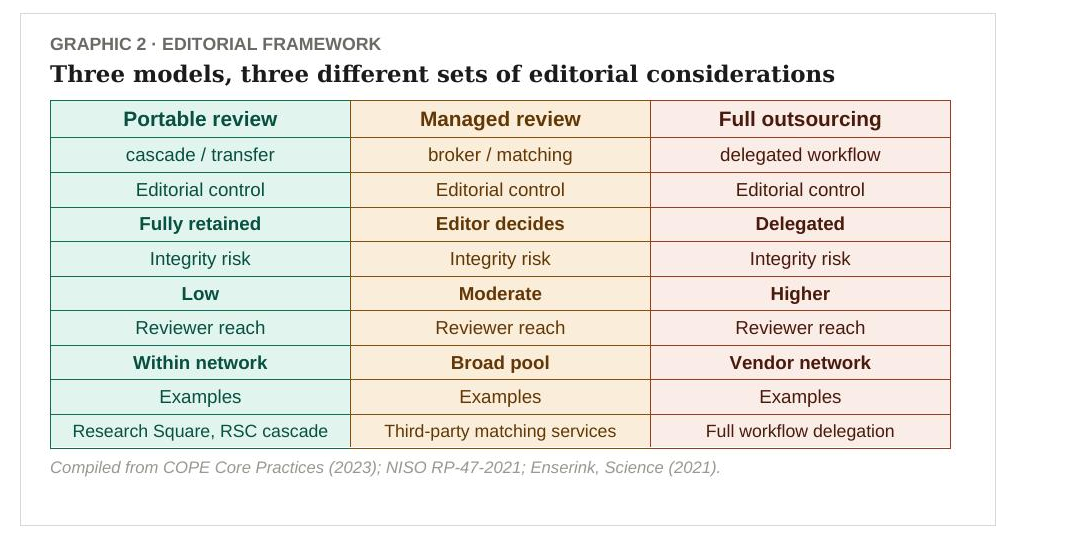
’Outsourcing peer review’ covers arrangements that carry very different implications, and the debate often confuses them.
Portable or transferable peer review lets reviews complete at one journal travel with the manuscript to another. The Royal Society of Chemistry and several Springer Nature journals operate cascade systems along these lines. The PEERE research network, an EU Horizon 2020 project, documented how much reviewer time the current system wastes by discarding prior reviews at each submission.⁶
Managed review brokering uses third-party services to identify reviewers, manage correspondence, and run quality checks while the editor retains decision authority. Wiley’s Peer Review Partner Program, aimed at society journals with limited administrative infrastructure, operates broadly in this space.
Full workflow outsourcing, where an external company manages the entire process for a journal, is the model that generates the sharpest questions. Fifteen journals adopted versions of this arrangement in 2021, as reported in Science.³
The Case For Outsourcing
The benefits, when implementation is sound, are substantive enough to take seriously.
Faster and more consistent operations. Dedicated platforms with reviewer databases and structured workflows can shorten time-to-first-decision and free editors to focus on decisions rather than logistics. For society journals with rotating volunteer editors, this kind of operational backbone is a genuine quality upgrade.
Engaged reviewers, matched by expertise. The traditional model concentrates requests on the most recognisable names in a field, many of whom review out of obligation. Matching platforms can connect manuscripts with reviewers whose recent work aligns directly with the methods or topic at hand. The IOP 2024 data found that intellectual engagement with the work was the most commonly cited reason reviewers said they enjoyed peer review.¹² Systems that prioritize relevance over seniority reinforce that motivation.
Meaningful inclusion of the Global South. IOP 2024 shows researchers in low- and middle-income countries receive far fewer review requests than counterparts in high-income countries. 10% say they receive too many, compared to 30% in high-income settings.¹ This gap is reflective of informal editorial networks rather than reviewer capacity. Third-party platforms with genuinely international databases can correct this systematically in ways individual editorial boards often cannot, strengthening review quality by bringing in diverse research approaches and regional perspectives currently underrepresented.
Portable review reduces redundant work. The PEERE network documented how much reviewer time the current system wastes when prior reviews are discarded each time a manuscript moves journals.⁶ Cascade systems address that directly.
The Case Against, Or At Least For Caution
The concerns are also documented and serious.
Editorial identity gets harder to maintain. The choosing of a reviewer is in itself an editorial act. Who a journal asks to evaluate a paper — what expertise, what methodological tradition, what level of skepticism — can shape the outcome. When that choosing process happens through a vendor operating across dozens of journals, journal-specific character is harder to express.
Reviewer accountability changes. A reviewer recruited through a database for a journal they do not personally read carries a different professional stake than one engaged through the discipline’s own networks.
Integrity vulnerabilities are not hypothetical. More than 8,000 papers were retracted in 2023, the highest annual figure on record. A significant proportion of these were linked to compromised peer review – fake reviewer accounts, paper mill submissions, and manipulated reviewer suggestion systems.⁴ The affected journals were major commercial titles where submission volume had grown faster than oversight infrastructure. The underlying vulnerability predates outsourcing, but distributing review across more parties without explicit, auditable standards at each layer increases exposure.
Some researchers are pulling back deliberately. A 2025 paper in Accountability in Research found that some academics are declining review invitations not from fatigue but as a deliberate response to commercial review arrangements they find troubling. The authors distinguish “reviewer refusal” from “reviewer fatigue.”⁵ Publishers should know which of the two explains their decline rates, because the solutions differ.
What the Field’s Standards Already Require
The scholarly publishing field of peer review has done much of the work of defining responsible implementation. COPE’s Core Practices (2023) require that editors retain publication decisions, reviewer confidentiality is preserved, and any third-party involvement is disclosed.⁷ The NISO Peer Review Taxonomy
Standard (2021) sets baseline expectations for how journals describe their review processes.⁸ Silverchair’s Future of Peer Review 2025 report notes that author scrutiny of journal processes is increasing year over year.⁹
 Other Questions That Come Up Time and Again
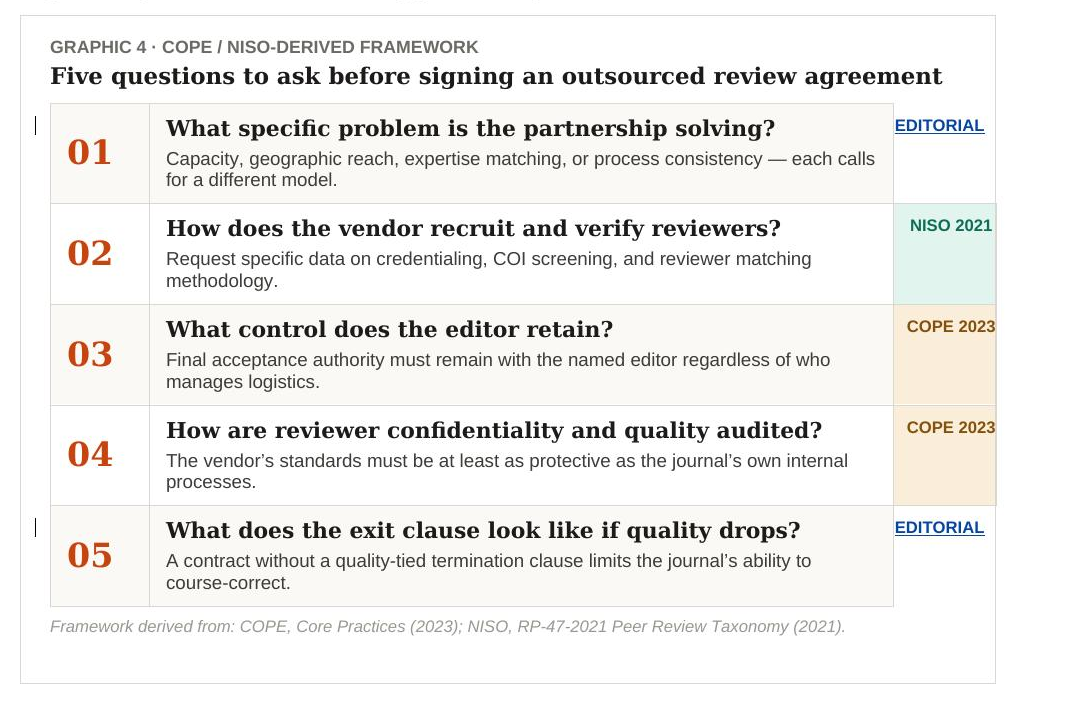 Other Questions That Come Up Time and Again
Is outsourced peer review unethical? Not inherently. COPE distinguishes outsourcing review management, which is acceptable with proper oversight, from outsourcing editorial judgment, which is not. The conditions are documented and not particularly burdensome.⁷
Is the reviewer shortage actually getting worse? The picture is nuanced. IOP Publishing’s 2024 survey found that 84% of respondents said they had appropriate review loads or more capacity than requests would fill, up from 74% in 2020. The real problem is concentration: senior researchers in high-income countries carry a disproportionate share while capacity in lower-income countries and at earlier career stages is underused.¹
Are portable review systems the same as full outsourcing? No. Portable review reduces redundant work by letting prior reviews follow a manuscript. The reviews were conducted by independent experts and the receiving editor still decides. The ethical implications are materially different from full workflow delegation.
What about retraction risks? Over 8,000 papers were retracted in 2023, many linked to compromised peer review.⁴ The vulnerabilities are structural and not specific to outsourcing, but any model that distributes review across more parties needs explicit, auditable standards at each layer. Enago Academy’s analysis of the retraction crisis traces the pattern across major publishers.
The Bottom Line
Outsourced peer review is not a single thing, and it does not require a single position. Portable review and cascade transfer have a strong evidence base for reducing waste in the system. Managed review services can broaden reviewer pools, including into the Global South in ways traditional networks have not managed. Full workflow outsourcing carries more substantial questions about editorial identity and quality control.
The decision for any individual publisher about the acceptability of outsourcing in principle, and more about the details – which model, for which problem, with which vendor, under what contract terms. The frameworks for answering these questions already exist. Publishers who use them carefully, recognizing the benefits as well as the cautions, will making better decisions than those who do not engage with it at all.
For broader perspective on where the practice is heading, Enago Academy’s analysis of the future of peer review covers possibilities and challenges from an editorial workflow perspective.