“United in Purpose” Is Easy to Say. Here’s What It Takes to Put It into Practice.
Why research integrity can fail at handoffs—and how to make responsibility visible.





Research integrity is often described as a shared responsibility. In practice, it depends on a chain of trust. Institutions expect researchers to understand and follow relevant standards. Authors expect journals to screen submissions appropriately. Editors rely on peer reviewers to assess the work within the scope of the review. Reviewers, in turn, rely on editors and publishers to carry out the checks assigned to them, including relevant data and image screening. Readers expect the published record to be accurate, transparent, and kept up to date.
Each expectation is understandable. Together, they create a chain in which every link depends on the next. Yet the phrase “shared responsibility” can conceal an execution gap: each participant assumes that someone else has already performed the check. It is the publishing equivalent of a crowded kitchen in which everyone assumes someone else has already salted the soup.
COPE’s Publication Integrity Week 2026 is centered on the theme “Rooted in principles. United in purpose.” The principles are widely endorsed; the challenge is translating them into practice. What is often missing is clear ownership: shared responsibility can become an assumption that someone else has completed the necessary check. The response is not to make every participant responsible for everything, but to agree on checkpoints, assign responsibility for each one, and make the results visible to the next person in the process.
The Industry Already Recognizes the Principle
The industry does not lack commitment. Springer Nature describes research integrity as a responsibility that is shared by authors, editors, reviewers, and the wider research community. This reflects a basic reality: no single participant can safeguard the integrity of scholarly publishing alone.
When responsibility is described as shared but no one specifies who checks what or when the result can be a chain of assumptions. Integrity risks do not arise only within individual stages; they can also emerge at the handoffs between them.
Where the Handoffs Break Down
Publication Pressure – An Underlying Risk Upstream of Every Handoff
A survey of 720 researchers by the Asian Council of Science Editors found that 38% reported feeling pressured to compromise research integrity because of publication demands, and 61% believed institutional publication requirements contribute to unethical practices. The findings point to a tension between metric-driven expectations and ethical research conduct. When publication counts become a major currency in hiring, promotion, or funding decisions, pressure can extend beyond the laboratory. It may shape behavior at multiple points in the publication process and create conditions that paper mills can exploit. Pressure is not itself a handoff failure, but it helps explain why checks get skipped: when speed is rewarded and verification is invisible, the incentive is to assume that someone downstream will catch the problem.
Editors Cannot Assume that Reviewers Will Catch Every Problem
In a study published in the Journal of the Royal Society of Medicine, 607 BMJ peer reviewers assessed manuscripts into which nine major methodological errors had been deliberately introduced. On average, reviewers identified 2.58 of the nine errors. The authors cautioned editors against assuming that peer reviewers will detect most major methodological errors.
This is not a criticism of reviewers, who often work within limited time and without a clearly defined mandate to verify every aspect of a submission. Rather, it highlights the need for editors to define what reviewers are expected to assess, and what remains with the editorial office. If reviewers catch fewer than a third of major errors, a journal that treats peer review as its integrity screen has a gap that no one owns.
Journals and Institutions Need Reliable Channels of Communication
The Cooperation and Liaison between Universities and Editors (CLUE) recommendations identify barriers to communication and coordinated action between journals and research institutions. Journals may struggle to identify the appropriate research-integrity contact at an institution, while institutions may not receive timely, actionable information from journals. COPE’s guidance emphasizes that effective cooperation among journals, publishers, and research institutions depends on clear communication, designated points of contact, and an appropriate balance between transparency and confidentiality. Without a named contact on each side, a concern raised by a journal can stall between organizations, with each assuming that the other is acting.
The Responsibility Continues After Publication
Retraction should help correct the scholarly record, but its effects do not automatically carry through to later citations. In their analysis of 13,252 post-retraction citation contexts in PubMed Central, Hsiao and Schneider found that only 5.4% acknowledged the retracted status of the cited work. The finding suggests that issuing a retraction notice does not, by itself, ensure that subsequent authors recognize or communicate that status when citing the work.
These studies examine different points in the research and publishing lifecycle. They show the gap, not the solution. Taken together, they illustrate three distinct vulnerabilities: peer review cannot be expected to detect every methodological problem; journal–institution communication requires clear channels and designated contacts; and retraction notices do not guarantee that later citations will acknowledge a work’s status.
One Handoff. One Accountable Owner. One Visible Check
Being united in purpose does not mean everyone checks everything. It means assigning responsibility for each relevant check and ensuring that the next person in the process can see what was checked, by whom, and when.
Table 1. Handoff ownership at a glance
| Handoff | Accountable owner | Check | Visible record |
| Author → journal | Corresponding author (with coauthors and institution where appropriate) | Documented pre-submission review | Pre-submission check declaration |
| Editor → reviewer | Handling editor | Defined review scope; which checks stay with the editorial office | Scope statement in the review invitation |
| Reviewer → editor | Editorial office or publisher integrity team | Image, data, and other assigned screening | Screening record kept with the manuscript file |
| Post-publication | Journal, with institution and publisher | Retraction notice, institutional notification, linked status | Documented response time; notice linked wherever the paper appears |
At the author-to-journal handoff, the corresponding author should coordinate a documented pre-submission review, with co-authors and the institution contributing where appropriate. A manuscript-screening tool such as Enago Reports may support selected technical and integrity-related checks before submission. However, these reports do not replace editorial judgment or the journal’s own checks.
At the editor-to-reviewer handoff, the handling editor should define the review scope clearly, including which aspects reviewers are expected to assess and which checks remain the responsibility of the editorial office or publisher. Journals may also provide structured support tools.
At the reviewer-to-editor handoff, the editorial office or publisher’s research-integrity team should retain responsibility for any screening assigned to it, including appropriate checks of images, data, and other submission elements. Where appropriate, the journal may compare its own screening results with checks documented by the authors. Comparing results does not establish that all concerns have been resolved; however, it can make the process more transparent by creating a record of which checks were performed and what they found.
At the post-publication handoff, the journal should own the retraction notice and its visibility, the institution should share relevant findings and name an integrity contact, and the publisher should keep the notice linked to the paper wherever it appears. The visible check is a documented response time and a notice that readers and later authors can easily find.
One principle applies to every handoff above: technology supports the process, but it does not own the decision. Accountability stays with a named person: the author who signs the declaration, the editor who decides, and the publisher who sets the screening policy.
From Shared Principles to Shared Accountability
For COPE Publication Integrity Week 2026, our call to the research and publishing community is simple: name who owns each link in the chain, and make that ownership visible to the next party.
One practical starting point would be for journals to ask authors to disclose which pre-submission checks were completed, by whom, and when. This could sit alongside existing submission declarations, including disclosures about AI use where required by the journal. Such a declaration would not prove that the checks were adequate, but it could make the process more transparent and give editors a clearer basis for follow-up. To keep the burden proportionate, journals should specify which checks they expect authors to report.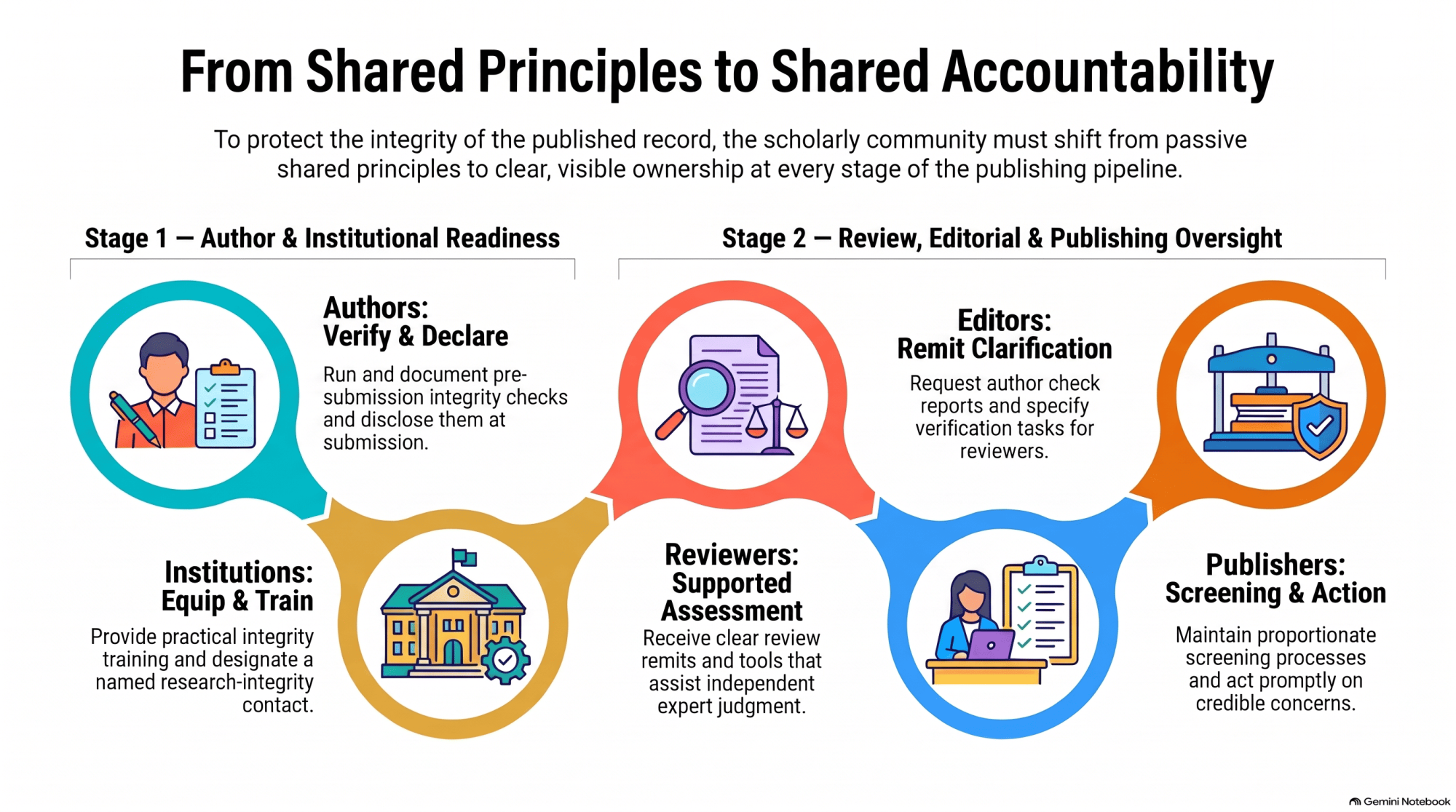
Disclaimer: The image was generated using Gemini Notebook for illustration purpose.
In practice, responsibilities could be allocated as follows:
- Authors: Complete and document the checks relevant to the study and the journal’s requirements; disclose the checks performed when requested.
- Institutions: Provide practical training, maintain clear procedures for handling concerns, and identify an appropriate research-integrity contact.
- Reviewers: Receive a clearly defined review scope, appropriate guidance, and tools that support—not replace—independent expert judgment.
- Editors: Ask authors to report relevant pre-submission checks; define the reviewers’ remit; and make clear which checks the editorial office will conduct.
- Publishers: Establish proportionate screening processes, provide clear routes for institutional communication, and act promptly on credible concerns to help maintain the accuracy and integrity of the published record.
Being united in purpose must mean more than endorsing the principles of publication integrity. It must mean putting those principles into practice: assigning responsibility for each check, recording what was done, and ensuring that the information reaches the next person who needs it. Shared purpose becomes meaningful when accountability is visible throughout the publication process.