
The Long Tail of AI Errors: 550 days of misinformation!


Historically, the scientific community has operated under a foundational assumption: once a manuscript survives peer review and achieves publication, the primary obstacle to validation has been overcome.
That assumption may no longer hold true. As large language models and automated tools become integrated into literature discovery, note-taking, drafting, and editorial workflows, research integrity concerns are extending far beyond the point of submission.
Publishers, research integrity teams, and independent researchers are expanding their scrutiny to encompass the entire research lifecycle, interrogating not just the final manuscript, but the provenance of the data and logic that formed it.
Recent empirical data underscores the severity of this shift. An analysis of 764 retracted AI-related papers revealed a median time to retraction of 550 days. For more than 16 months, structurally flawed or fabricated data remained active within the scientific record.
A broader examination tracking thousands of machine learning and AI retractions highlights a deeper challenge within the scholarly publishing ecosystem: retracted papers often continue to influence subsequent research. Data reveals that top-cited papers frequently experience a perverse distortion in academic attention, receiving up to eight times more citations post retraction. As 71.7% of these problematic papers are published in open access formats and heavily concentrated in highly ranked Scopus Q1 journals, their flawed conclusions spread with little resistance.
This results in systemic propagation of misinformation where fraudulent, manipulated, or deeply flawed AI data continues to actively shape downstream literature long after it has been discredited.
Consequently, the metric of success for researchers can no longer simply be: “Will this pass peer review?” The critical question is now: “Can this withstand rigorous scrutiny long after publication?”
Redefining the Publication Lifecycle
The growth of generative AI necessitates a cultural shift in scientific publishing. Publication is now the beginning of a continuous, transparent lifecycle of post-publication scrutiny. To meet this standard, research institutions and editorial boards must implement a dedicated Pre-Submission AI Risk Audit, owned jointly by the corresponding author and the institution’s research integrity office. Before any manuscript is submitted for peer review, authors must systematically answer four decisive operational questions:
- Has every citation been verified to exist in an index of record?
- Does every citation precisely support the specific sentence it follows?
- Was any AI summary accepted into the text without a direct audit of the primary source?
- Have any conclusions or abstracts been broadened by automated tools beyond what the raw data supports?
The corresponding author records the answers to these four questions, along with any citations flagged for replacement, in the manuscript’s methodology or acknowledgment section before submission. If the audit surfaces an unresolved discrepancy, such as a citation that cannot be verified against a primary database, submission is paused until the research integrity office signs off. Researchers using Enago Reports can run this check directly through the Citation Checker tool, which validates references against Crossref and flags retracted, predatory, or non-existent sources before they reach a journal editor.
The 550-day figure describes papers specifically flagged for AI-related issues; it is one data point within a much older retraction-lag problem, not evidence that AI created it. However, the extended latency between publication and retraction is particularly damaging because AI-driven errors are rarely isolated. A single fabricated reference, distorted summary, or misaligned citation fundamentally compromises the framing of a study, warps its methodological rationale, and propagates errors across multiple sections of the final text.
The Anatomy of the Compounding AI Error Workflow
To safeguard research integrity, publishers and researchers must recognize how minor verification failures compound across the four major stages of the manuscript lifecycle.
Stage 1: Literature Discovery and Horizon Scanning
The initial risk emerges before manuscript drafting begins. As researchers increasingly use AI tools to map research landscapes, synthesize vast volumes of literature, and generate reading lists. While operationally efficient, these tools introduce systemic vulnerabilities:
- Fabricated or Incomplete Citations: The generation of hallucinated or incomplete reference strings.
- Seminal Omissions: The failure of algorithmic filters to capture foundational, non-digitized, or structurally divergent studies.
- Algorithmic Bias: The overrepresentation of specific high-velocity viewpoints creating an echo chamber that reinforces a researcher’s initial hypotheses rather than rigorously testing them.
Literature discovery establishes the hypothesis, defines the knowledge gap, and justifies the study design. An incomplete or inaccurate representation due to algorithmic distortion at this stage may compromise the research project before the first sentence is written.
Stage 2: Literature Review and Note-Taking
The second risk emerges when researchers rely solely on AI-generated summaries instead of reading original studies closely. AI-generated summaries can accelerate information processing, but they frequently strip critical context. Automated summarization tools may soften methodological limitations, omit conflicting findings, and overgeneralize population-specific data into universal conclusions.
The danger now is the silent accumulation of micro-errors: an empirical finding interpreted too strongly, a critical confounding variable omitted, or two separate methodologies blended into a singular narrative. As these errors migrate into internal notes and conceptual frameworks, they achieve a false status of factuality within the research group simply through repetition. This overreliance results in:
- Misinterpreted empirical findings
- Loss of vital scientific context
- Oversimplification of complex data sets
- An inaccurate baseline understanding of prior research
Stage 3: Draft Development
Early-stage inaccuracies are embedded within polished, highly persuasive prose during drafting. AI-assisted writing tools excel at synthesizing language and proposing transitions, but they can simultaneously inject unsupported assertions, create citation-claim mismatches, or project unwarranted confidence onto speculative interpretations.
At this stage, the compounding effect becomes critical. One unverified AI output can dictate the direction of the introduction, reappear within the discussion, and shape the abstract or conclusion. Because AI-generated prose can appear structurally fluent and scientifically plausible, these errors are exceptionally difficult to detect via standard editorial reading, allowing weak or fabricated claims to formalize into a draft.
Stage 4: Revision and Submission
As a manuscript nears submission, it undergoes iterative revisions involving multiple co-authors, editors, and reviewers. Paradoxically, this stage can unintentionally dilute accountability rather than strengthening it. As text blocks are shifted and edited across distributed teams, the responsibility for verifying individual sentences becomes diffuse; rarely does a single investigator recheck every AI-assisted insertion back to its primary source material.
Furthermore, traditional peer review is not designed to detect these distributed errors. Reviewers evaluate conceptual novelty, methodological validity, and high-level significance; they do not retrace every AI summary or audit every citation back to the original source text. This operational limitation explains why fundamentally flawed papers survive peer review and persist in the literature until post-publication analysts uncover the systemic patterns of error.
Peer review has carried integrity gaps for decades, retraction lag predates generative AI in most disciplines, and AI tools are themselves increasingly deployed to catch fabricated citations and manipulated data, not just produce them. What has changed is volume and velocity: the same verification failures that once arrived one at a time now arrive at the speed and scale of automated drafting, across thousands of manuscripts simultaneously.
The Downstream Impact on the Scientific Ecosystem
Research integrity crises rarely stem from singular, catastrophic acts of misconduct. They are almost universally the product of a succession of minor validation failures: an unchecked reference, a summary accepted in lieu of reading the primary paper, an undisclosed AI insertion, or a claim accepted without empirical validation.
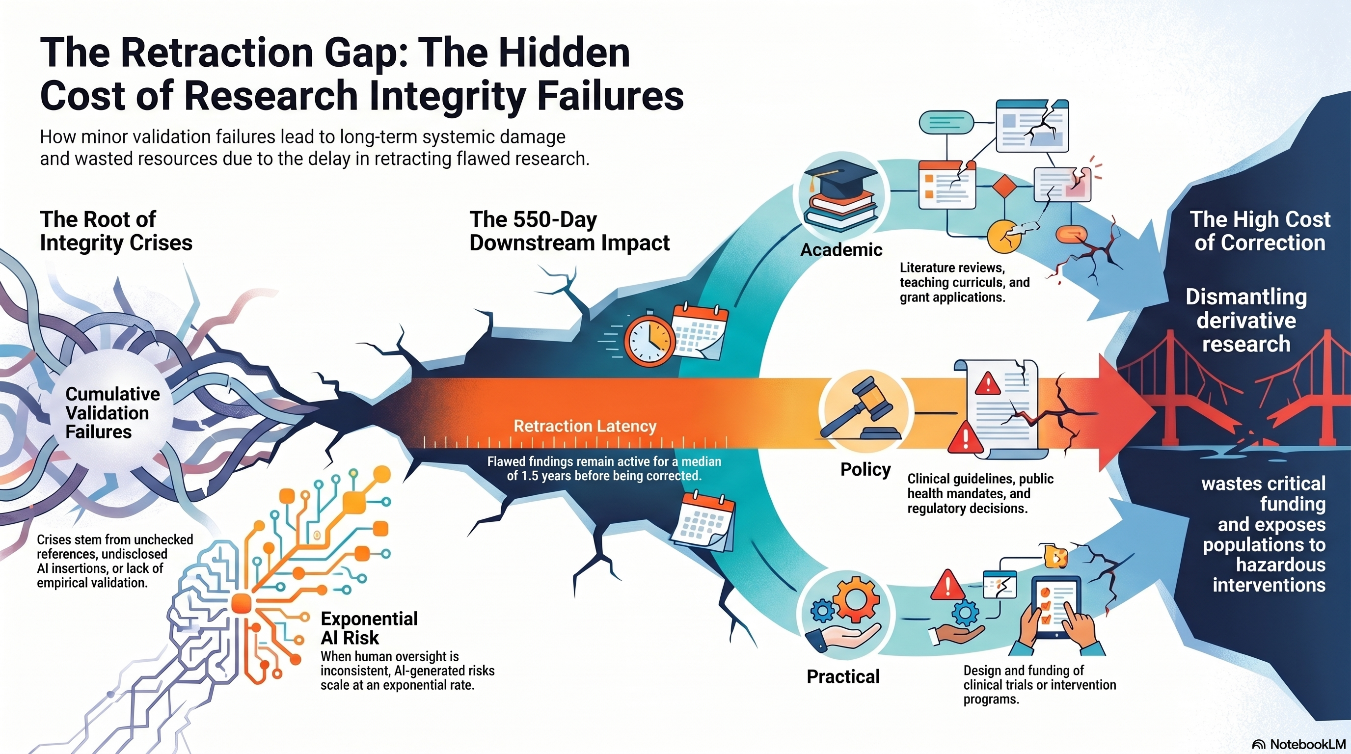
When human oversight is inconsistent, AI risks scale exponentially. The 550-day median latency to retraction creates severe downstream consequences across the broader scientific and societal ecosystem. During this window, flawed findings are:
- Incorporated into literature reviews, teaching curricula, and subsequent grant applications
- Integrated into clinical guidelines, public health mandates, and regulatory policy decisions
- Used to inform the design and funding of downstream clinical trials or public intervention programs
Once the foundational evidence base is revealed defective, correcting the scientific record requires retracing and dismantling multiple layers of derivative research — wasting critical funding, delaying genuine scientific progress, and potentially exposing populations to ineffective or hazardous interventions.
As institutions move from AI experimentation to responsible implementation, faculty and academic leaders increasingly need practical, discipline-specific guidance rather than broad policy recommendations. Enago’s Responsible AI Initiative supports this transition through expert-led workshops and webinars that equip educators with actionable frameworks for ethical AI adoption, governance, and classroom integration. Designed specifically for research communities, these sessions help faculty navigate the evolving AI landscape with confidence while fostering a culture of responsible and transparent AI use.
Retractions do not originate on the day of publication; they are set in motion months prior by unverified algorithmic shortcuts. Research integrity in the modern era demands that human verification remains active, continuous, and absolute from the initial literature search to long after the paper enters the global scientific record.
Similar Articles


.png)

Load more