
Why Disclosure Templates Matter: A Practical Guide for Researchers


A growing number of manuscripts now involve an invisible collaborator. Not a co-author. Not a statistician. Not even a professional editor.
A prompt.
Somewhere between drafting an abstract, reorganizing a discussion section, refining language, or debugging code, researchers are integrating generative AI into everyday scholarly workflows. In many labs and research offices, this no longer feels remarkable. What remains uncertain is where assistance ends and disclosure obligations begin.
Over the last two years, publishers, editorial organizations, and research integrity bodies have released numerous AI guidance documents. Yet most policies differ in structure, terminology, disclosure thresholds, and placement requirements. One journal asks for a formal declaration. Another expects disclosure buried in the Methods section. Some require naming the model version; others only ask for “appropriate transparency.” Researchers are increasingly expected to comply with standards that are still evolving in real time.
The result is a growing documentation gap.
AI Disclosure is Required, but Rarely Standardized
Many researchers are not deliberately hiding AI use. They are navigating a system where expectations remain fragmented, examples are inconsistent, and the line between “editing assistance” and “reportable contribution” often feels unclear. This is precisely why disclosure templates are becoming essential infrastructure rather than an administrative formality.
Emerging evidence suggests researchers are using AI more often than they disclose it. Publisher policies increasingly require authors to specify:
- Which tool was used
- What version or system was used
- How it was used
- Whether outputs were verified by humans
- Where AI contributed in the workflow
Yet disclosure instructions vary significantly across journals. Elsevier, for example, provides a formal declaration structure for manuscript writing assistance, while Springer Nature generally expects disclosure in Methods or an equivalent manuscript section. Taylor & Francis requires naming the tool, version, purpose, and reason for use.
Without structured templates, researchers often default to vague disclosures such as:
“AI tools were used during manuscript preparation.”
In many cases, this level of disclosure may be insufficient.
What a Good AI Disclosure Template Should Include
A well-drafted disclosure answers three questions.
1. What Tool was Used?
Be specific.
Weak:
“An AI tool assisted writing.”
Strong:
“Sections of the discussion were refined using OpenAI ChatGPT (GPT-5) for language clarity.”
Specificity helps editors evaluate whether usage aligns with policy expectations.
2. What was the Purpose?
Clarify the task.
Examples:
- Language refinement
- Structural editing
- Literature summarization
- Code debugging assistance
- Brainstorming conceptual framing
Avoid broad statements like: “Used for manuscript preparation.”
That tells editors almost nothing.
Use a specific, comprehensive statement like: “These tools were used for assistance in Research & Literature (searching for relevant papers, organizing literature); Language & Writing (adjusting tone and style); Data & Visualization (editing figure 1).”
3. What Level of Human Oversight Occurred?
This is often the most important element.
Publishers consistently emphasize that authors retain full responsibility for accuracy, originality, and interpretation. AI cannot be listed as an author because it cannot assume accountability.
A strong disclosure states this explicitly:
“All outputs were critically reviewed, revised, and validated by the authors.”
A well-constructed disclosure template does three things simultaneously:
- It helps researchers communicate AI use more precisely.
- It reduces ambiguity for editors and reviewers.
- It creates a defensible record of human oversight and accountability.
In other words, templates standardize transparency before transparency becomes a compliance crisis.
A Researcher’s Pre-Submission Disclosure Checklist
Before submitting, ask:
- Tool transparency: Did I name every AI tool used?
- Version clarity: Did I specify version/model where possible?
- Purpose specificity: Did I explain exactly what each tool did?
- Human oversight: Did I confirm independent review and validation?
- Scope boundaries: Did I clarify what AI did not do?
- Journal alignment: Did I check the target journal’s exact disclosure location requirements?
- Authorship integrity: Is no AI system listed as author/co-author?
If any answer is “no,” revise before submission.
A Smarter Way to Generate Disclosure Statements
Because journal policies differ, manually crafting compliant disclosures can be frustrating and error-prone. Disclosure templates and tools like the Enago AI Disclosure Statement Generator are not bureaucratic overhead. They protect researchers in several important ways:
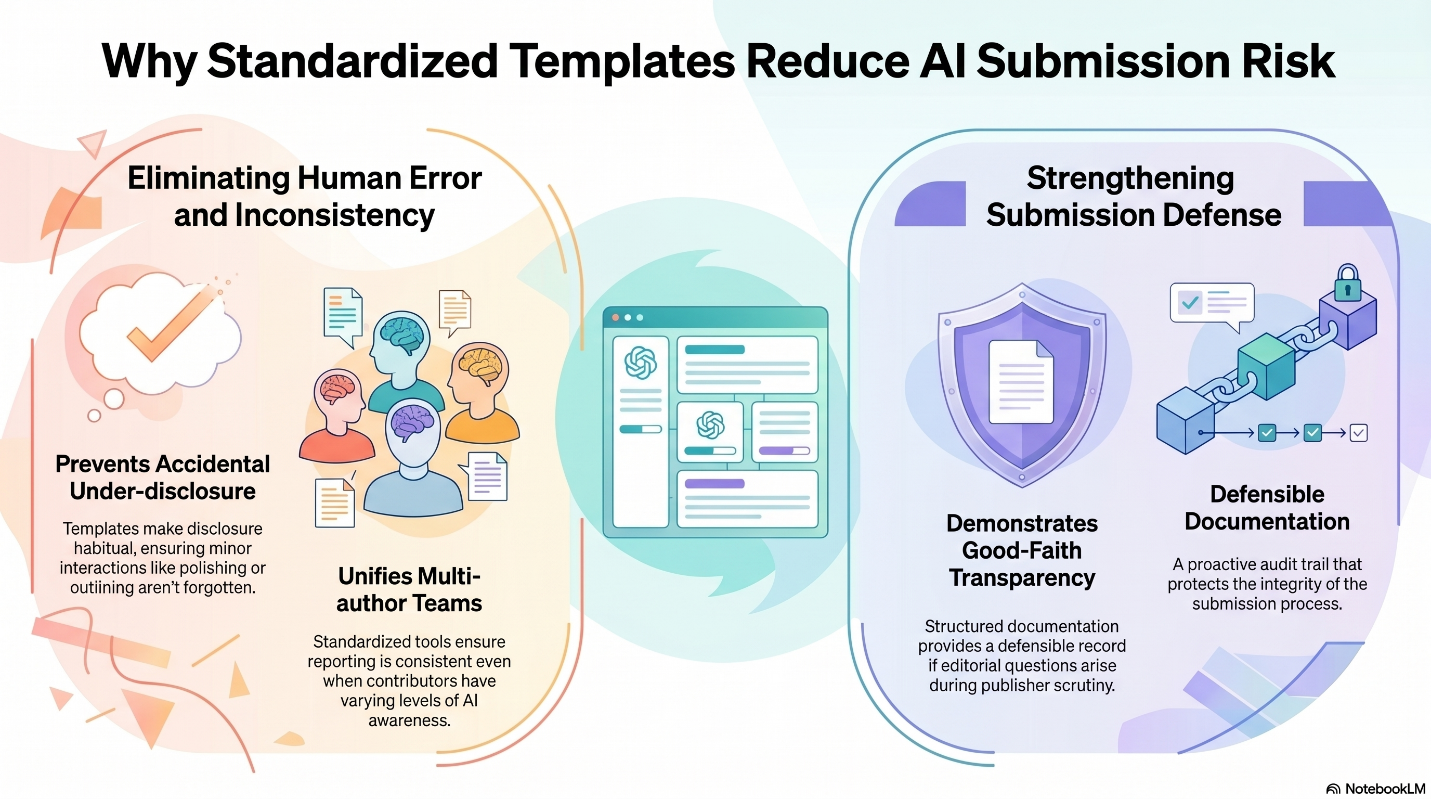
Tools like the Enago Responsible AI Disclosure Generator help researchers generate structured AI disclosure statements tailored to:
- The tool used
- Purpose of use
- Human oversight level
- Workflow contribution
- Publisher-aligned transparency expectations
Instead of guessing what editors expect, researchers can create disclosure language that is clearer, faster, and easier to defend during review.
As AI policy expectations continue to evolve, disclosure should not be an afterthought. It should be part of the writing workflow itself.
The Bottom Line
The future of responsible AI use in research will not be defined solely by whether authors use AI.
It will be defined by how clearly they disclose it.
Templates matter because transparency is only useful when it is consistent, specific, and actionable.
Researchers who adopt structured disclosure practices now will be better positioned to meet publisher expectations, avoid compliance friction, and strengthen trust in their work.
And with tools like the Enago AI Disclosure Generator, creating those disclosures no longer needs to be complicated.
Similar Articles

.png)

Load more