
Why Business and Management Researchers Face a More Complex Journal Ranking Landscape Than STEM Researchers


A STEM researcher making a submission decision may primarily consider whether the journal is indexed in Scopus and Web of Science and its Impact Factor quartile. However, business and management researchers face a different challenge. Beyond confirming Scopus or Web of Science indexing, many also weigh discipline-specific business journal ranking systems, such as the Australian Business Deans Council (ABDC journal ranking) Journal Quality List, the Chartered Association of Business Schools (Chartered ABS) Academic Journal Guide (AJG), and the Financial Times Research Rank (FT50). Depending on institutional promotion, graduation and accreditation standards, publishing in one journal may carry a different academic valuation than publishing in another journal with similar citation performance. For example, a Scopus-indexed journal often holds different positions in the ABDC and ABS guides, and a journal with high citation impact sometimes falls outside the FT50 List.
No single metric can capture journal quality across the diverse fields under business and management—accounting, finance, economics, organizational behavior, marketing, and public policy each have different citation patterns, publication volumes, and research traditions. As a result, business researchers cannot rely on the narrower set of indicators typical in STEM, and must navigate multiple ranking frameworks simultaneously.
A More Complicated Ranking Landscape
In business and management, journal choice rarely depends on a single system alone. Two ranking systems shape most publication decisions in the field: the ABDC Journal Quality List and the Chartered ABS Academic Journal Guide.
The Chartered Association of Business Schools (Chartered ABS) Academic Journal Guide (AJG) categorizes journals into five ratings, ranging from 1, 2,3,4,4*. The guide combines bibliometric evidence with expert peer review and editorial judgment, rather than relying on citation counts. According to the Chartered ABS, this approach supports informed evaluation rather than replacing expert judgment.
The Australian Business Deans Council (ABDC) Journal Quality List was established to provide an internationally recognized reference for business schools, researchers, and higher education institutions. ABDC Journal classifies journals into four tiers: A*, A, B, and C. Reviewers combine expert disciplinary judgment with quantitative evidence to place each journal in a tier. Though the list originated in Australia, universities across many regions now use it for academic promotion, recruitment, doctoral evaluation, and research benchmarking.
The two systems overlap in purpose but differ in origin, structure, and regional adoption. ABDC sorts journals into four tiers, while AJG breaks quality into five bands, distinguishing the highest-impact journals with a 4* rating above the standard 4 category. Many business schools refer to both systems, as a journal rated highly in one system typically ranks near the top in the other, though exact placements sometimes differ. A journal may receive a higher rating in one framework than another or may not appear on institutional priority lists such as FT50, requiring researchers to balance competing expectations.
Alongside these widely used frameworks, some business schools continue to place particular emphasis on the Financial Times Research Rank (FT50). Unlike the ABDC or AJG, the FT50 does not assess the quality of all business journals. Instead it identifies 50 specific journals to calculate research output for global MBA and business school rankings. Institutions aiming to boost visibility often push faculty for FT50 publication, leaving researchers to balance school ranking targets alongside of ABDC rankings, AJG, Scopus, or Web of Science criteria.
Each framework answers a different question. AJG and ABDC ask how the field regards a journal. FT50 asks whether a publication supports institutional ranking performance. For business researchers, one publication decision carries a layered explanation, covering academic fit, institutional expectations, and administrative requirements.
Publishing Pressures Take Different Shapes Across Regions
East Asia's national assessment exercises now run alongside global rankings rather than replacing them. China's "Breaking the Five Only" reform, launched after 2020, pushed universities to reduce their reliance on the Science Citation Index and journal-based metrics. Yet a peer-reviewed analysis of the reform's effects on “Double First-Class Universities” found that international paper output continued to rise even after the policy took hold, while domestic output showed little change. The finding points to global journal ranking pressure persisting even as the reform took shape.
Southeast Asia shows a more blended pattern. Indonesia's SINTA system, introduced in 2016 on Scopus publication data, gives researchers a national research score that weighs highly cited Scopus-indexed journals more heavily. The system functions as a national tool built directly on an international database rather than as an alternative system.
In the Middle East, the pressure takes a different form: national research mandates tied to economic transformation goals. Saudi Arabia's Vision 2030 has been associated with a rapid rise in the presence of Saudi universities within global ranking systems. Analysis of this rise finds the growth in highly cited output is spread across fields without a consistent long-term research strategy, showing rapid ranking gains without always having the supporting structure needed to sustain that growth.
In addition to these regional patterns, a more fundamental access gap persists. Researchers in lower- and middle-income countries face real barriers to publishing in top-tier journals due to higher article processing charges (APCs), limited fee-waiver coverage, and English-language publishing conventions that disadvantage non-native speakers. Collaborations between developing-economy and advanced-economy researchers land in top-tier journals significantly less often than comparable US-based collaborations, even after controlling for citation performance.
A Practical Way Forward
This layering does not need to be treated as an obstacle to overcome. The complexity reflects a domain that evaluates quality by more than one metric. When navigating multiple business journal ranking systems, researchers need a method to narrow down choices without losing sight of fit.
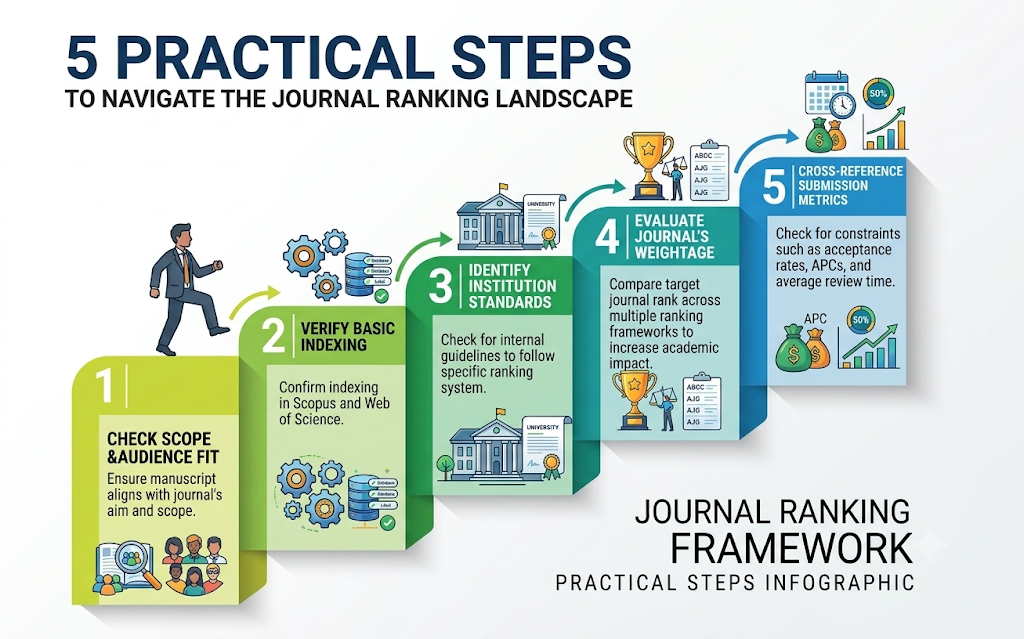
Follow these 5 practical steps to navigate multiple ranking systems:
- Check scope & audience fit – Ensure manuscript aligns with journal’s aim and scope.
- Verify basic indexing – Confirm indexing in Scopus and Web of Science.
- Identify Institution standards – Check for internal guidelines to follow specific ranking system.
- Evaluate Journal’s weightage – Compare your target journal rank across multiple ranking framework to increase academic impact.
- Cross-reference submission metrics – Check for constraints such as acceptance rates, APCs, and average review time before final selection.
When balancing these layered system, an expert service like Enago's Journal Selection Assistance can offer a way to navigate the submission choices. A PhD expert from the same research field will evaluate the manuscript and match it with suitable journals based on scope fit, indexing status, impact factor, and author expectations, returning three to five tailored recommendations. Each recommendation includes a full report covering indexing status, publisher details, review model, fees, and the manuscript’s publication readiness, built around the layered questions business researchers face rather.
The layered nature of journal selection in business and management is not a weakness. The layering reflects a field that values research quality from various perspectives. Understanding how ABDC, AJG, FT50, Scopus, and regional systems complement each other allows researchers to make publication choices that extend the reach of their work and support long-term academic and professional goals. Unlike researchers in many STEM disciplines, business and management researchers rarely make journal decisions using a single ranking framework.
Quick Reference
| Framework | Primary Purpose | Who Maintains it? | How Journals are Evaluated | Typical Use in Business & Management |
|---|---|---|---|---|
| Scopus (CiteScore/SJR) | Global Abstracting and Indexing Database | Elsevier | Indexed journals receive metrics such as CiteScore, SJR, and SNIP based on citation data. | Demonstrates international visibility, indexing status, and citation performance |
| Web of Science (Journal Citation Reports) | Global Citation Indexing and Bibliographic Analysis | Clarivate | Journals are evaluated using the Journal Impact Factor (JIF), the Journal Citation Indicator (JCI), and related metrics. | Widely used for research evaluation, funding, and institutional performance across disciplines |
| ABDC Journal Quality List | Discipline-specific journal quality assessment | The Australian Business Deans Council | Expert review supported by quantitative evidence; journals classified as A*, A, B, or C | Commonly referenced for promotion, recruitment, doctoral assessment, and publication planning |
| Chartered ABS Academic Journal Guide (AJG) | Discipline-specific assessment of business and management journals | Chartered Association of Business Schools | Peer review combined with bibliometric evidence; journals rated from 1 to 4* | Frequently used by business schools to guide publication strategies and academic evaluation |
| Financial Times Research Rank (FT50) | Benchmarking the research performance of business schools | Financial Times | Curated list of 50 leading journals used in FT business school rankings | Often incorporated into institutional research strategies, particularly among globally ranked business schools. |
Similar Articles









Load more