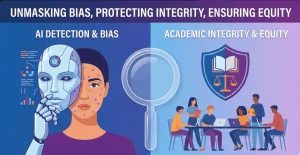
Generative AI is now embedded in scholarly workflows: Turnitin reported that its detector reviewed more than 200 million student papers and found that 11% contained AI-generated language in at least 20% of the text, with 3% of submissions flagged as predominantly AI-generated. This rapid uptake reflects both opportunity and risk for researchers who use AI to write, summarize, or draft references.
For authors and mentors, the central problem is not whether AI can write, but whether humans can reliably separate helpful assistance from misleading output including invented facts, incorrect citations, and superficially plausible arguments. This article argues that researchers must develop two complementary skills discernment (critical verification of AI outputs) and conceptual clarity (precise framing of research ideas) and offers a practical framework to reduce ethical, methodological, and editorial harms while retaining the productivity benefits of AI.
Table of Contents
Why AI Helps — And Where It Fails
Is your manuscript being flagged as AI-written?
Many publishers now run AI checks at submission. Get a paragraph-level detection report — including paraphrased AI content — free, in 10 minutes.
Check Your Manuscript Free →AI tools accelerate routine tasks. Literature discovery assistants and LLMs can summarize papers, suggest phrasing, and generate readable first drafts, saving time in early-stage writing and helping non-native English speakers communicate more effectively. Vendor and academic tools designed for research (for example, tools trained on scientific corpora) often produce better domain-appropriate wording than general-purpose chatbots.
However, modern LLMs are also prone to hallucination generating content that is coherent but factually incorrect or fabricated. Hallucinations include made-up references, wrong numbers, or invented methodological details presented with unwarranted confidence. Examples:
- Fabricated references in medical prompts: An experimental study that tested ChatGPT on 20 medical questions found 69% of the 59 references evaluated were fabricated despite appearing plausible; authors warned users to scrutinize references before using them in manuscripts.
- Reference hallucination score (RHS): A JMIR study proposed and applied an RHS to several AI chatbots and found wide differences in reference fidelity; domain-oriented tools (Elicit, SciSpace) performed notably better than general chatbots like ChatGPT and Bing on bibliographic accuracy.
- Detection and adversarial evasion: Technical research shows that many AI-detection methods can be circumvented by straightforward adversarial edits, demonstrating that detection alone cannot be the only safeguard for responsible AI use.
Conceptual Clarity Reduces Risk of Error
A clear conceptual scaffold a tightly defined research question, explicit operational definitions, and a transparent evidence map makes AI use safer and more productive. When the research question and inclusion criteria are precise, AI outputs are easier to test and correct. For example, prompting an AI with a clearly defined PICO (Population, Intervention, Comparator, Outcome) structure or specifying exact citation formats reduces ambiguity and lowers the chance of fabricated or irrelevant references.
Conceptual clarity also supports peer review and reproducibility. A manuscript that explicitly states hypotheses, data sources, and analytic choices makes it straightforward for reviewers to check claims and for authors to validate AI-assisted text against primary records.
Discernment: Practical Verification Steps for Authors
Researchers must adopt a verification workflow whenever AI contributes to scholarly content. The following essential checks form an evidence-first approach:
- Confirm sources: Verify every citation the AI supplies by locating the original paper or DOI, and confirm authorship, title, journal, and year. Automated checks do not replace human confirmation; studies show many citations generated by LLMs are incorrect or fabricated.
- Cross-check factual claims: For key numbers, methods, or claims, compare the AI output with the primary literature or original datasets rather than relying on secondary summaries.
- Use specialized tools for bibliographic retrieval: Tools designed specifically for literature discovery (some academic chatbots and domain tools) show lower rates of reference hallucination than general chatbots in published comparisons. Prioritize domain-optimized services when generating references.
- Track AI use and human oversight: Document what the AI produced, what the human review changed, and how the final text was verified. This is consistent with emerging publisher guidance calling for disclosure plus human verification.
Prompt Hygiene: How to Reduce Hallucination
Thoughtful prompting reduces spurious output. Researchers should:
- Ask for verifiable outputs only: Request DOIs, PubMed IDs, or exact quotations and instruct the model to answer “I don’t know” if it cannot verify.
- Limit speculative synthesis: Avoid prompts that ask the model to invent literature gaps or novel data without clear supporting evidence.
- Use iterative prompting with verification steps: Generate a draft paragraph, then ask the model to list sources; next, verify each source before integrating the paragraph into the manuscript.
- Prefer tools that support retrieval augmentation (RAG) or that are indexed against a curated scientific corpus; these models produce fewer fabricated citations than open-ended LLMs. Evidence shows such domain-aware systems often score better on reference fidelity.
Maintaining Authorship, Responsibility, and Transparency
Major editorial bodies have set clear norms: AI cannot be credited with authorship because it cannot assume responsibility for accuracy. Researchers must remain accountable for content and disclose substantive AI assistance in the methods or acknowledgement sections according to their target journal’s policies. Enago’s Responsible AI Movement emphasizes disclosure plus mandatory human verification as a practical standard for research authors.
A Concise Action Checklist for Researchers
- Define the research question and inclusion criteria before using AI.
- Use domain specific AI retrieval tools when generating citations.
- Verify every AI-provided citation against the primary source.
- Document AI use and human verification steps in manuscript materials.
- Have at least one subject-matter expert review and sign off on factual claims and references.
Conclusions and Recommendations
Generative AI will remain a valuable part of the research toolkit. To use it responsibly, researchers must build two capabilities: rigorous discernment to detect and correct hallucinations, and firm conceptual clarity to ensure AI outputs align with explicit research goals. Supplement these skills by (1) selecting domain-appropriate tools, (2) verifying every citation and factual claim against primary sources, (3) documenting AI use and human oversight, and (4) prioritizing clear research framing before AI-assisted drafting.
For authors who want support putting these practices into operation, human-plus-AI services can help verify references, check factual accuracy, and prepare a submission-ready manuscript. For example, Enago’s AI English editing + expert review service combines an academic AI engine with subject-matter editors who flag AI-introduced errors and verify scientific claims, while the Responsible AI Movement provides resources and toolkits for best practices.
Samuel Anderson is a strategic business alliance at Trinka and Enago, he has partnered with organizations, institutions, and platforms that care deeply about responsible AI use, data privacy, and high-quality writing as AI is becoming part of everyday writing workflows, many teams, especially in research, healthcare, legal, and regulated environments are asking important questions about where their data goes, how it’s used, and whether confidentiality is truly protected.