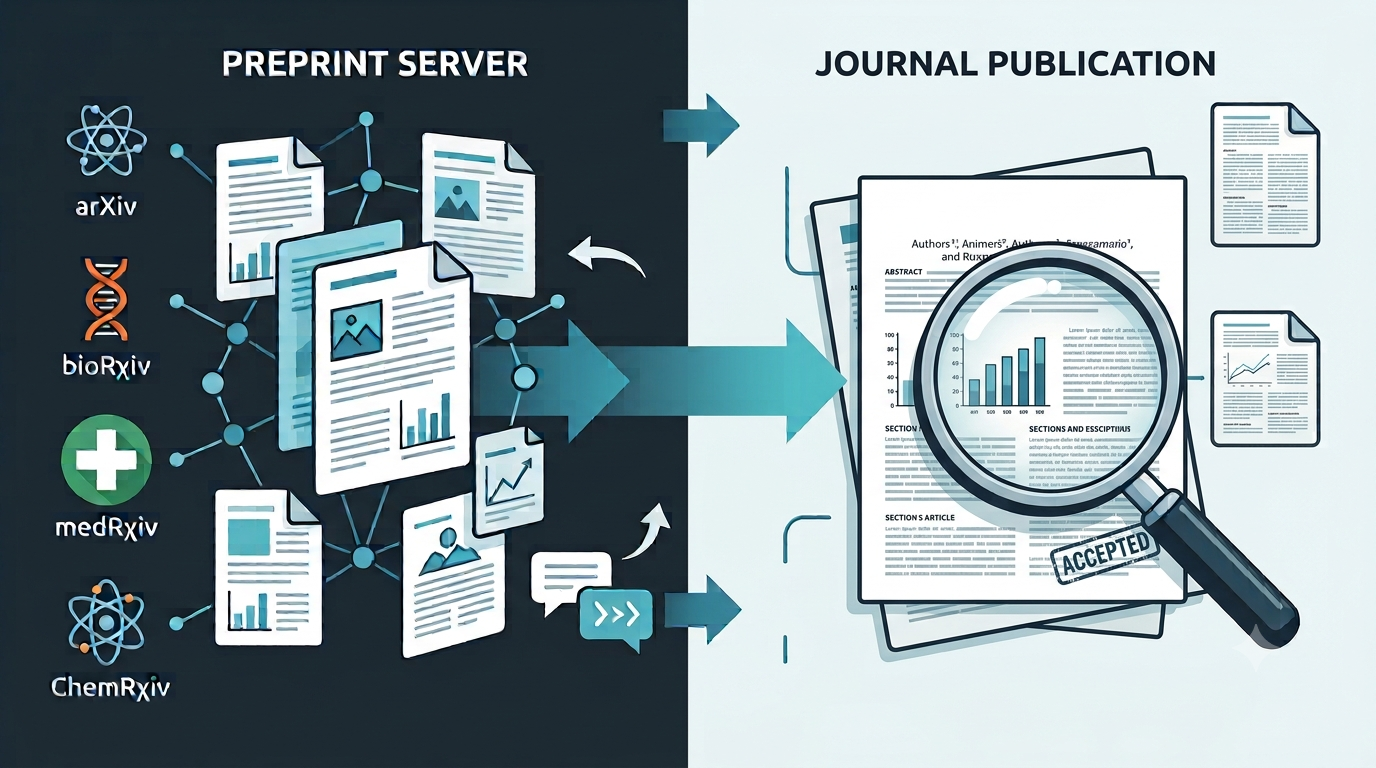
An analysis of bioRxiv’s history by Abdill and Blekhman (2019), published in eLife, found that 42% of all bioRxiv preprints go on to formal journal publication, a figure that climbs past 50% within roughly a year of posting. What happens between posting a preprint and reaching formal publication, and how your choice of server impacts that process, is not widely understood. The rules, the review process, and even what counts as an acceptable revision differ across arXiv, bioRxiv, medRxiv, and ChemRxiv. Knowing these differences before posting can save real time later.
Table of Contents
What changes before publication is framing, not findings
Getting a preprint published usually comes down to one thing: tightening how the work is framed, not changing what was found. Yin and Rust (2026), in an analysis of 72,644 biomedical preprint-publication pairs posted to bioRxiv between 2018 and 2025, found that the central conclusion was unchanged in 39.9% of cases. Another 50% saw only minor revisions, with just over 10% undergoing major revision.
Where conclusions did shift, the same analysis found they moved toward more caution roughly twice as often as toward more confidence: 8.4% of findings adopted more cautious language after review, compared with 4.2% that became more assertive. It also found that biomedical papers never posted as preprints were retracted at roughly twice the rate of those that were, If anything, this points to the scrutiny preprints already attract rather than a shortcut around further review. A separate qualitative study by Stephen (2022), published in Scientometrics, examined 40 social science preprint-publication pairs and found reviewer comments split almost evenly between methodology (30.7%), theory (30.0%), and writing quality (29.2%), while two-thirds of citations remained unchanged between versions.
This pattern looked different during the acute phase of the COVID-19 pandemic. Brierley et al., writing in PLOS Biology, found that 17.2% of COVID-19-related preprints underwent major changes to their conclusions before publication, compared with 7.2% of non-COVID-19 preprints from the same period. This gap was a pandemic-era anomaly. Under normal circumstances, the version posted as a preprint and the version that eventually appears in a journal tend to be closer than many researchers expect.
The rules differ by preprint server, not just by field
How a preprint moves toward publication depends on which server hosts it as well as which field it belongs to. On arXiv, first-time submitters need endorsement from an established author in the same category before they can post. arXiv tightened this requirement in January 2026 after a flood of non-scientific submissions prompted it to stop accepting an institutional email address as sufficient grounds for automatic endorsement. bioRxiv and medRxiv, by contrast, rely on in-house staff and volunteer affiliates to screen for scope and potential harm rather than scientific validity. medRxiv applies an additional layer of scrutiny given the stakes of clinical research, including a standing caution that its preprints should not guide clinical practice.
bioRxiv in particular has become closely associated with early-career researchers, who often post a preprint to demonstrate productivity for grant applications and job searches while the same manuscript is still working through formal review elsewhere. Xie, Shen, and Wang (2021), in a thirty-year analysis of preprint servers, found that publication rates vary sharply by discipline: 69% for physics and 51% for mathematics, while medRxiv reached 32% of papers published within its first year alone. The same analysis found that economics preprint servers diverge widely from one another. NBER’s eventual publication rate runs close to arXiv’s, SSRN’s is less than half of NBER’s, and RePEc’s is under 10%. Where a preprint is posted shapes its likely fate as much as the field it belongs to.
ChemRxiv operates differently again. According to ChemRxiv’s own FAQ page, the server is co-owned and jointly managed by five chemical societies, including the American Chemical Society and the Royal Society of Chemistry. Its screening also explicitly excludes copyediting or typesetting. The version posted is the exact version that appears publicly. That structure also gives ChemRxiv a free Direct Journal Transfer feature, letting authors submit straight to participating ACS, RSC, GDCh, and other partner journals from their dashboard, though only before a manuscript has received a final acceptance decision elsewhere.
Publishers are more receptive than most researchers assume, with real exceptions
Concern about a journal rejecting a manuscript because it was already public is largely outdated, though not entirely unfounded. Da Silva and Dobránszki (2019), surveying 14 major academic publishers, found that the share with a formal preprint policy rose from 64% in 2017 to 78% within about a year. A separate assessment by Massey, Opare, Wallach, Ross, and Krumholz (2020), published in JAMA Network Open, examined the 100 clinical journals with the highest impact factors and found that 86% allowed preprints, with another 13% deciding case by case and only one journal prohibiting them outright. Nature Portfolio’s own policy, described on its self-archiving and license to publish page, states that preprints may be posted at any time during the peer review process and will not be considered prior publication.
Exceptions still exist, and they tend to cluster by field rather than appear at random. Leopold, Haddad, Sandell, and Swiontkowski (2019) announced, in an editorial published concurrently in Clinical Orthopaedics and Related Research, The Bone & Joint Journal, the Journal of Orthopaedic Research, and the Journal of Bone and Joint Surgery, that these four journals would not accept clinical research manuscripts previously posted to a preprint server, a policy that has remained in place since it was introduced. Chemistry publishers tend to take a different approach: Wiley’s preprint guidelines for Angewandte Chemie require authors to declare the preprint to the editor and include its DOI, rather than restricting it outright. The practical lesson holds regardless of field: check the specific policy of the destination journal directly, rather than assuming either full openness or automatic rejection.
What to check before, and after, you post
Two habits reduce friction regardless of field or server. Before posting, authors should confirm their target journal’s preprint policy directly, since the range documented by da Silva and Dobránszki, and by Massey and colleagues, runs from full acceptance during review to outright refusal depending on the field and publisher. After posting, formatting deserves particular attention: a preprint is not submission-formatted for any specific journal, even one that reads cleanly, and ChemRxiv preprints in particular carry no copyediting or typesetting at all by design.
The framing of the work matters just as much as its formatting. As the Yin and Rust (2026) and Stephen (2022) analyses both suggest, where conclusions do shift between preprint and publication, the movement is usually toward more careful hedging and better-supported claims rather than new data or a different method entirely, precisely the kind of scrutiny a structural edit or a pre-submission review is built to catch before a reviewer does.
Moving from preprint to publication
Posting a preprint changes when research becomes visible, not how rigorously it will eventually be reviewed. The server hosting it shapes what happens next more than most researchers expect, from arXiv’s endorsement requirements to ChemRxiv’s direct-transfer partnerships to medRxiv’s added caution around clinical claims, and the destination journal’s own disclosure and timing policies vary enough that checking directly, rather than assuming, is worth the few minutes it takes.
For researchers preparing to move a preprint toward a specific journal, the most common gap is rarely the underlying science; it is how that science is framed and formatted for the destination. Researchers who want a second set of eyes on that gap may find that Enago’s Substantive Editing service, which focuses on structure and argument rather than language alone, or its Top Impact Scientific Editing service, which adds a mock peer review to flag overreaching claims or unacknowledged limitations, can help close it before a reviewer does. Either can be a useful second check for a manuscript that has already had its moment of public visibility and is now heading toward the more exacting scrutiny of formal review.