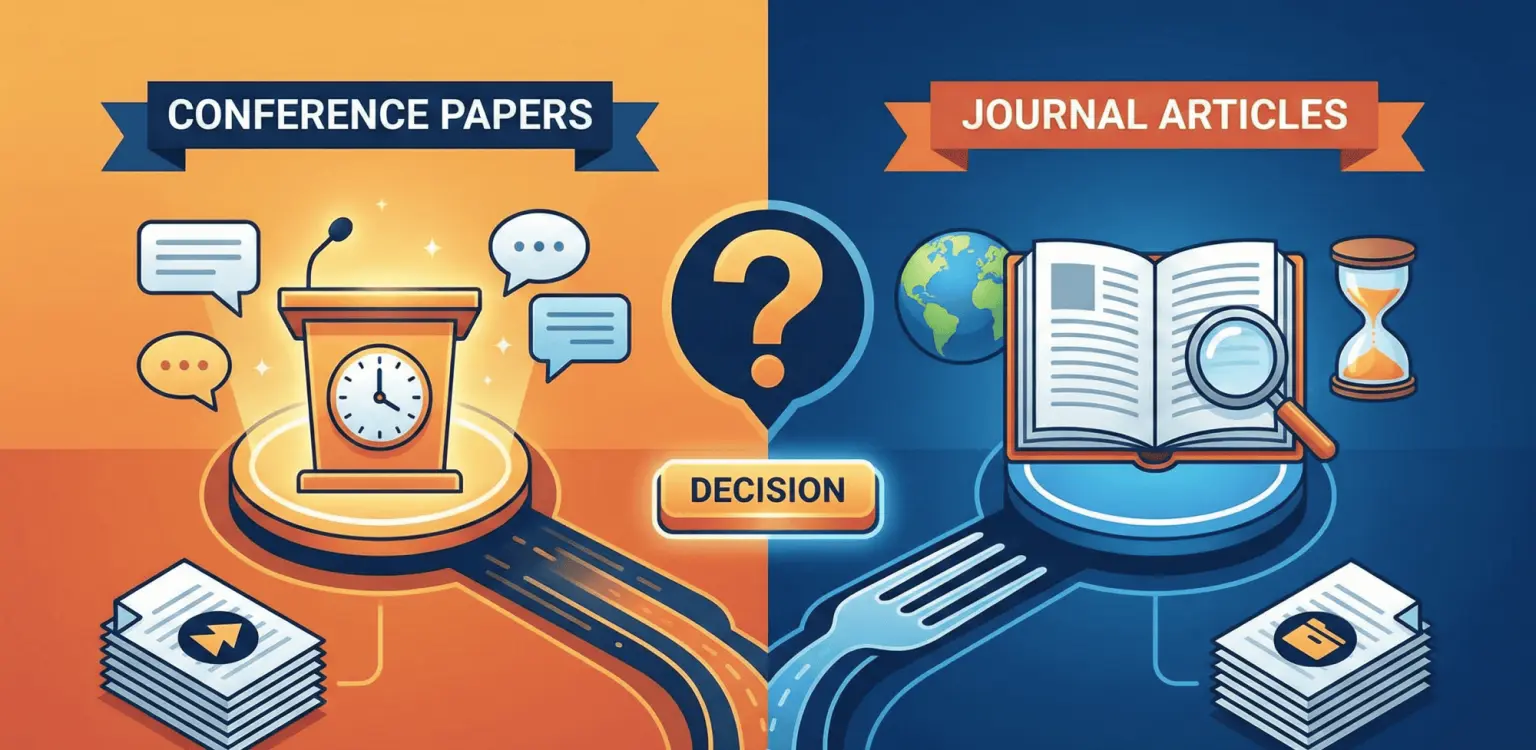
In engineering and computer science (CS), choosing between conference papers vs. journal articles can shape how fast your findings reach the community and how your research publication record is assessed later. Many researchers face the same manuscript decision: should the next study go to a conference proceedings paper or a journal article? There’s no universal rule because publication norms differ by subfield, and evaluation criteria vary across institutions and regions.
This article compares the academic value of conference proceedings and journal publications, with special attention to engineering/CS realities: peer review rigor, timelines, visibility, how to convert a conference paper into a journal article ethically, and what each format can mean for career progression. It closes with a practical decision lens you can apply to your next submission.
Table of Contents
What counts as a “conference paper” versus a “journal article”?
A conference paper is typically published in a conference’s proceedings and is often linked to a presentation (oral or poster). In many CS and some engineering areas, flagship conferences serve as primary archival venues, and conference proceedings papers can carry significant prestige. In other areas (for example, many branches of traditional engineering), proceedings are treated as preliminary outputs, while journals remain the definitive scholarly record.
A journal article is published in an ongoing journal (often in issues/volumes) and usually represents a more complete and deeply validated contribution. Journals typically expect stronger methodological detail, fuller experiments, and more extensive positioning against prior work than proceedings papers.
Because norms vary, it helps to compare conference proceedings papers and journal articles using concrete dimensions: peer review, speed, contribution type, indexing/discoverability, and how committees weigh outputs.
Peer review rigor: not just “conference is lighter, journal is stricter”
A common assumption in the research publication process is that journals always apply more rigorous peer review than conferences. In practice, review rigor depends on the venue, the field, and the review model.
- Conferences: Many apply time-bound peer review with strict deadlines and page limits. That structure can limit how much revision is possible before acceptance decisions, even when reviews are high quality. Some conferences also rely on a single review round, which can reduce opportunities for iterative improvement compared with journals.
- Journals: Usually allow multiple revision cycles (major/minor revisions). Reviewers may request additional experiments, deeper error analysis, stronger statistical treatment, or expanded theoretical justification. This iterative process often improves completeness and reproducibility, but it also extends the publication timeline.
In top-tier CS, however, selectivity and scrutiny can be intense at premier conferences. Metrics-based evaluation in CS may treat publications at selective conferences as a signal of research output, reflecting the field’s conference-centric culture (for example, CSRankings focuses on selective conferences as an evaluation signal).
Practical takeaway: Judge “rigor” venue-by-venue. A strong conference can be as competitive as a strong journal, but journals more consistently support deeper revision and fuller reporting.
Speed and visibility: the engineering/CS trade-off
When research needs rapid dissemination new architectures, security vulnerabilities, systems benchmarks, or fast-moving AI methods conferences often provide a clearer path to timely exposure. A conference date anchors the workflow: submission deadline, decision date, camera-ready deadline, and presentation.
Journals can be slower due to reviewer availability and multiple revision rounds. That slower timeline can be a disadvantage when the topic moves quickly, but it can be an advantage when long-form validation and completeness matter more than early visibility.
Visibility also depends on where the paper will be discovered:
- Community Reach: Proceedings may be widely read in conference-centric communities.
- Interdisciplinary Reach: Journals are often easier to interpret across disciplines and may be preferred by evaluators outside CS (for example, interdisciplinary committees or funding panels).
- Indexing: Some proceedings are indexed and heavily used; others are less visible depending on publisher, series, and database coverage.
Practical takeaway: Conferences often maximize speed and community attention; journals often maximize cross-disciplinary interpretability and long-term archival signaling.
Contribution type: what each format is best suited for
| Format | Best Suited For… |
|---|---|
| Conference Paper | Time-sensitive contributions, novel methods with early/compelling experiments, system designs with strong benchmarks, or urgent negative results. |
| Journal Article | Comprehensive reporting, expanded datasets, ablation studies, robustness checks, deeper theory, multi-site validations, or extended proofs. |
Some fields have hybrid models. For example, SIGGRAPH technical papers are presented at the SIGGRAPH conference while also functioning as journal-style archival publications under an associated journal model.
Practical takeaway: Match the venue to the shape of the contribution: focused and time-sensitive versus comprehensive and fully validated.
Career progression: how committees often interpret proceedings and journals
Career impact is rarely determined by format alone. Committees typically evaluate a combination of venue reputation, selectivity, citation impact, and the researcher’s role. Still, engineering/CS researchers often encounter mixed expectations:
- In CS Departments: Top conferences are explicitly recognized as leading venues; evaluation models may count them as heavily as (or more than) journals.
- In Engineering/Interdisciplinary Schools: Journals often carry clearer weight especially for promotion, tenure, or evaluation by administrators less familiar with conference prestige signals.
Practical takeaway: Publication planning should be tied to the researcher’s real evaluation context, not only community norms.
Converting a conference paper into a journal article: what, why, and how to do it ethically
What “extended version” typically requires
Most publishers expect the journal submission to include substantial new content. While requirements vary, common expectations include:
- Expanded experiments or new datasets.
- Deeper analysis or additional theoretical contributions.
- Broader validation or improved methodology reporting.
Ethical Guidelines & Policies
- Springer: Emphasizes disclosing/citing the conference version and ensuring the manuscript is sufficiently extended.
- ACM: Provides guidance on submitting revised versions, emphasizing transparency and compliance with policies.
- COPE: Offers resources on redundant publication for assessing overlap and novelty.
How to convert a conference paper into a journal article
- Check the target journal’s policy first. Many specify how they treat prior conference publications.
- Disclose the conference version in the cover letter. State clearly that the submission is an extended version and summarize what is new.
- Cite the conference paper in the journal manuscript. This clarifies provenance.
- Add substantial new intellectual contribution. Include new experiments, baselines, or theoretical results.
- Rewrite not just expand. Copy-pasting large blocks can raise self-plagiarism concerns. A journal article needs a stronger narrative.
- Align with journal standards. This includes fuller statistical reporting and structured templates.
- Document changes internally. Maintaining a change log helps when responding to reviewers.
Practical takeaway: The safest workflow is transparent disclosure + clear novelty + genuine rewriting to journal depth.
Common mistakes that weaken either format
- Conference Mistake: Over-claiming based on limited experiments due to page limits.
- Journal Mistake: Treating the submission like a longer conference paper without strengthening the contribution. Journals often reject papers that are merely “expanded” in length rather than expanded in insight.
- Disclosure Issues: Unclear handling of prior publication. Editors react poorly when overlap is discovered late or presented ambiguously.
Practical takeaway: Strong venue fit depends on meeting that venue’s implicit contract: conferences value focused novelty; journals value completeness and archival clarity.
Choosing the right format: a decision lens for the next submission
Your research, visualized by a subject matter expert.
A specialist from your research field reads your manuscript, creates the concept, and works with professional illustrators to deliver a journal-ready graphical abstract in 10 days.
Create Your Graphical Abstract →- Choose a Conference Paper when: Speed matters, the contribution benefits from early community feedback, and the target community is conference-driven.
- Choose a Journal Article when: The research is already mature, broader committees will evaluate the output, or credibility depends on extensive validation.
For many researchers, the most sustainable strategy is not “conference or journal,” but “conference then journal,” executed transparently and with real added value.
Final Recommendations
Deciding between a conference proceedings paper and a journal article isn’t about finding a “superior” format; it’s about choosing the right scaffolding for your specific discovery. Whether you prioritize the high-velocity “sprint” of a top-tier CS conference or the “marathon” validation of a traditional engineering journal, your choice should align with your long-term career blueprint.
Even with a clear understanding of the trade-offs, the sheer volume of modern publication venues can lead to “submission fatigue.” Rather than guessing which “impact factor” matches your data, a professional journal selection service provides:
- Aims & Scope Alignment: Ensuring your manuscript doesn’t face an immediate “desk reject” because it falls outside a journal’s specific niche.
- Metric-Driven Targeting: Balancing the need for high visibility (Impact Factor, CiteScore) with realistic acceptance probabilities based on your study’s depth.
- Predatory Guardrails: Protecting your professional reputation by filtering out low-quality or “pay-to-play” predatory journals.
Ultimately, the most successful researchers treat their publication record like a well-designed structure: a foundation of conference novelty topped with the permanent, weather-proof roof of journal articles. By using professional selection support, you ensure that every “brick” you lay is placed in the venue where it will have the most lasting impact.
Frequently Asked Questions
In many computer science fields, top conference papers carry equal or greater prestige than journal articles. In traditional engineering, journals are often weighted more heavily for evaluation and promotion.
Choose a conference paper when speed and early visibility matter. Choose a journal article when your research is mature and requires deeper validation or broader institutional recognition.
To ethically extend a conference paper into a journal article, disclose the prior version, cite it clearly, add substantial new content, and rewrite the manuscript to meet journal depth and reporting standards.
Yes, especially in conference-centric disciplines like computer science. However, evaluation committees in interdisciplinary or engineering contexts may prioritize journal publications.
Not always. While journals often allow multiple revision rounds and deeper validation, top-tier conferences can be equally selective and highly competitive depending on the field.
It can be considered redundant publication if the journal article does not add significant new intellectual contribution. Transparency, citation, and meaningful extension are essential to avoid ethical concerns.