Short, well-produced video abstracts can increase article visibility and social attention. Studies report higher article views, improved Altmetric scores, and—in some cases—modest increases in citations. This article defines the main formats of video abstracts favored by journals, explains how each approach works, and offers guidance on choosing the most suitable format based on discipline, journal requirements, and communication goals.
The sections below cover:
- Why video abstracts matter
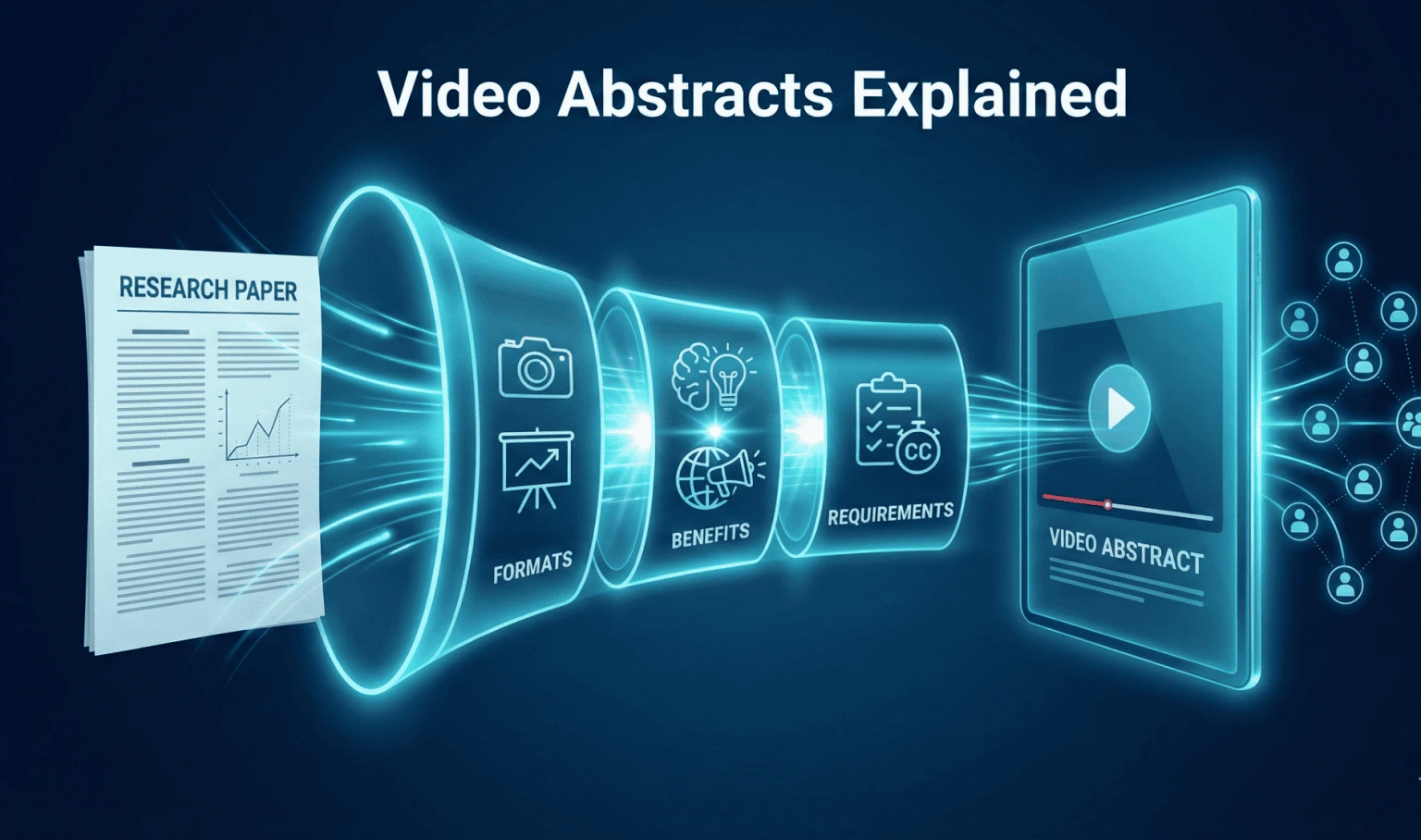
- Common formats and how they work
- Technical and ethical requirements
- When to choose each format
- Production tips and next steps for authors
Table of Contents
Why Video Abstracts Matter
Video abstracts act as visual and auditory summaries that complement the written abstract and extend a paper’s reach beyond traditional academic readers. Cross-sectional analyses of New England Journal of Medicine articles and cohort studies across disciplines show that papers with video abstracts are associated with:
- Higher article views
- Greater social attention (Altmetric scores)
- Small to moderate citation increases after adjusting for confounders
These findings suggest that video abstracts are effective dissemination tools, particularly for research that benefits from demonstration, visual explanation, or translation for nontechnical audiences.
Main Video-Abstract Formats and How They Work
Journals typically accept or promote several standard video-abstract formats. Each format differs in production effort, strengths, and ideal use cases.
Talking Head (Author on Camera)
How it works: The author speaks directly to the camera for 1–5 minutes, often supported by figures or slides.
Strengths:
- Builds trust and credibility
- Easy to produce with basic equipment
- Effective for clinical, social science, and policy research
Limitations:
- Less suitable for complex experimental demonstrations
- Some journals restrict author-identifying information during peer review
Narrated Slides / PowerPoint Voiceover
How it works: A narrated screen recording or exported slide video following the manuscript structure (background, methods, results, implications).
Strengths:
- Fast to create
- Closely mirrors the written abstract
- Well suited to data-driven disciplines (e.g., economics, epidemiology)
Limitations:
- Can appear visually static
- Requires strong slide design and concise narration
- Often subject to strict duration limits (≤3–5 minutes)
Animated Explainer
How it works: Motion graphics or illustrated animation present mechanisms, workflows, or models, typically in 2–4 minutes.
Strengths:
- Ideal for molecular biology, engineering, and modeling
- Simplifies complex processes
- Highly shareable on social platforms
Limitations:
- Higher production time and cost
- Effectiveness depends heavily on animation quality
Screencast / Methodology Demonstration
How it works: Real-time screen capture or laboratory footage demonstrates software, tools, or experimental procedures.
Strengths:
- Excellent for methods papers and technical tutorials
- Improves reproducibility and transparency
Limitations:
- Requires careful editing to remain concise
- Ethical and consent considerations apply for sensitive material
Graphical or Visual Abstract Video
How it works: A short (30–90 second) animated version of a graphical abstract, optimized for social media sharing.
Strengths:
- Highly effective for rapid dissemination
- Attracts non-specialist audiences
- Works well as a companion to longer videos
Limitations:
- Too brief for detailed methods or nuanced findings
- Best used as a gateway to the full article
Interview or Panel Format
How it works: An interviewer speaks with the author(s) or a panel discusses the study’s implications.
Strengths:
- Encourages interdisciplinary discussion
- Useful for public engagement and policy-oriented research
Limitations:
- Not accepted by all journals as a formal video abstract
- May conflict with double-blind peer-review policies
Technical and Ethical Requirements
Most publishers specify detailed technical and ethical standards. Common requirements include:
- File format: MP4 or MOV
- Aspect ratio: 16:9
- Frame rate: ≥15–20 fps
- Maximum duration: typically 3–5 minutes
Accessibility is increasingly mandatory. Subtitles or transcripts are strongly recommended – and often required. Videos featuring people or patients must include documented consent, and any third-party images, footage, or music must be cleared for reuse. Journals also vary in whether video abstracts may be submitted during peer review and whether anonymization is required.
Choosing the Right Format: Discipline, Goals, and Journal Rules
Select a video-abstract format based on three factors:
- Research content – methods, mechanisms, or conceptual insights
- Audience – specialists, practitioners, policymakers, or the public
- Publisher constraints – length, anonymization, file size, and accepted formats
General guidance:
- Demonstrating software or protocols → Screencast
- Explaining mechanisms or models → Animation
- Emphasizing credibility and implications → Talking head with figure callouts
- Maximizing social reach → Graphical abstract video (30–90 seconds)
- Engaging interdisciplinary or policy audiences → Interview or panel
Your research, visualized by a subject matter expert.
A specialist from your research field reads your manuscript, creates the concept, and works with professional illustrators to deliver a journal-ready graphical abstract in 10 days.
Create Your Graphical Abstract →Production Tips and Common Mistakes
Best practices:
- Keep videos concise (2–4 minutes; shorter for social clips)
- Prioritize audio quality
- Use captions or transcripts for accessibility
- Script around one clear message—avoid reading the manuscript verbatim
- Test playback on multiple devices
Common mistakes to avoid:
- Overlong videos with too many messages
- Poor audio or low-resolution visuals
- Missing permissions or consent documentation
Pre-Submission Checklist
- Confirm journal media guidelines and anonymization rules
- Prepare captions and transcripts
- Obtain written consent for identifiable subjects
- Create a clear thumbnail or still image
- Ensure file format and size meet journal limits
Evidence and Limits: What the Literature Shows
Research consistently links video abstracts with increased views and social engagement. Some studies also report modest citation benefits after controlling for confounders. However, results vary by discipline, journal, and video quality. These findings suggest that video abstracts should be viewed as part of a broader dissemination strategy – not as a guaranteed citation booster.
Conclusion and Next Steps
Video abstracts are a flexible, increasingly accepted tool for extending research reach. The most effective format depends on content, audience, and journal expectations. By following technical and ethical guidelines, keeping videos concise, and focusing on a single core message, authors can significantly enhance discoverability.
For authors looking to elevate their reach without the burden of production, Enago’s Video Development Service offers a seamless, expert-led solution. Our team of PhD subject matter experts and professional animators handles everything from scriptwriting to HD animation, ensuring your manuscript is transformed into an immersive story that is ready for both journal submission and social media promotion.
Frequently Asked Questions
A video abstract is a short visual summary of a research article that helps explain key findings and extend reach beyond traditional academic audiences.
Yes, studies show video abstracts are associated with higher article views and Altmetric scores, with modest citation increases in some disciplines.
Common formats include talking-head videos, narrated slides, animations, screencasts, graphical abstract videos, and interview-style discussions.
No, video abstracts are usually optional, but many journals encourage them to improve discoverability and research dissemination.
Journals typically require MP4 or MOV files, a 16:9 aspect ratio, captions or transcripts for accessibility, and durations of around 3–5 minutes.
Authors should consider their research content, target audience, and journal media guidelines when selecting a video abstract format.