A well-crafted abstract determines whether editors, reviewers, and busy readers engage with a manuscript. Medical and clinical editors frequently state that they may screen submissions by reading only the abstract, making its format and content a manuscript’s first gatekeeper. This article explains:
- The difference between structured and unstructured abstracts
- Where each format is appropriate
- Why following a journal’s required abstract structure matters for peer review (and for avoiding technical rejection)
- Practical steps researchers can take to choose and prepare the correct abstract for their field
Table of Contents
What Are Structured and Unstructured Abstracts?
Unstructured Abstracts
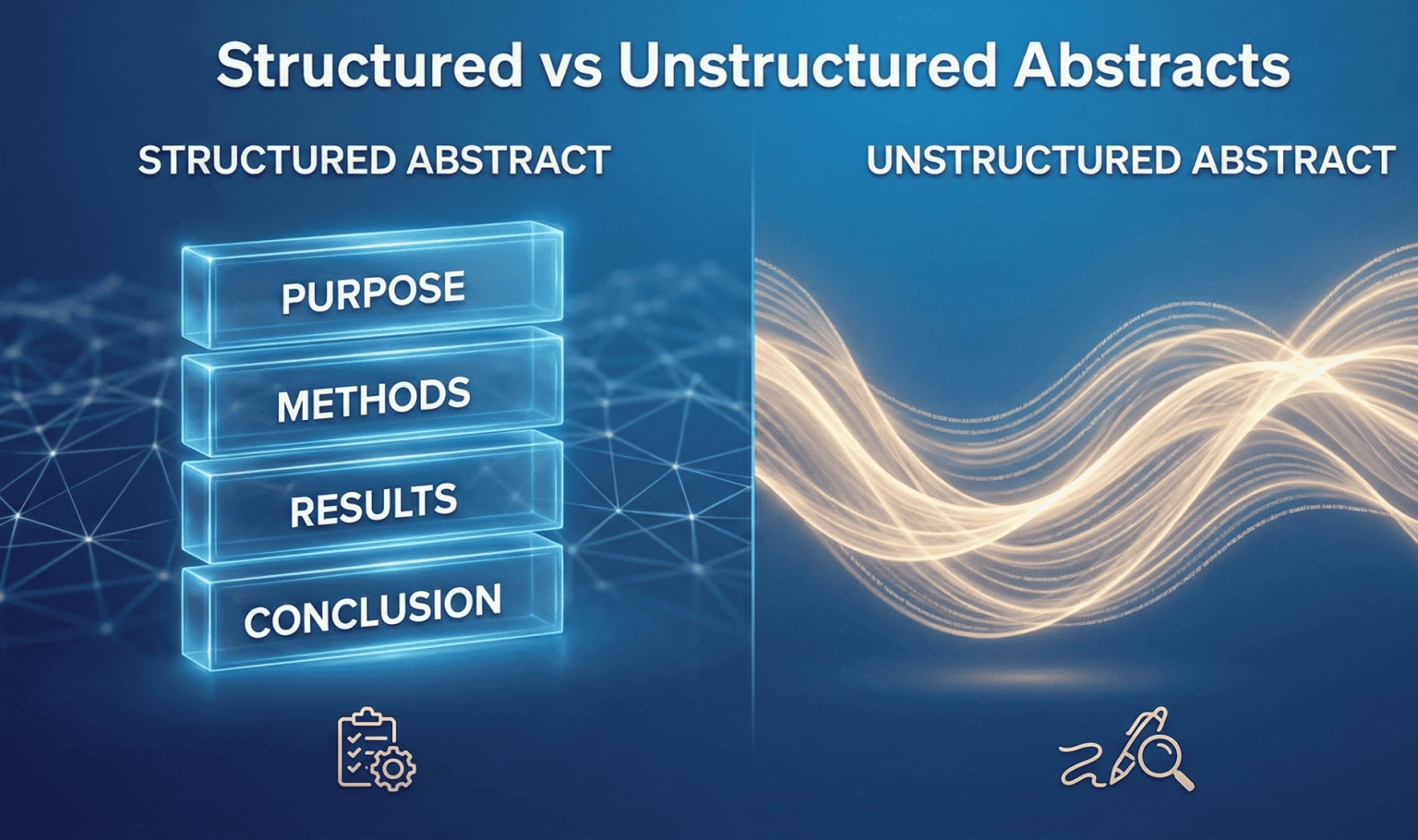
An unstructured abstract is a single, uninterrupted paragraph that summarizes the study’s:
- Purpose
- Methods
- Main results
- Conclusions
It remains common in many humanities and social sciences journals and in some physical science publications where a concise narrative suits the readership.
Structured Abstracts
A structured abstract divides the summary into labeled sections commonly:
- Background or Objectives
- Methods
- Results
- Conclusions
(often IMRaD-style or modified for specific article types).
Structured abstracts are explicit, standardized, and designed to present essential elements quickly and consistently for readers and indexers. Many clinical journals and reporting guidelines require structured abstracts because they improve clarity and allow rapid appraisal of study design and findings.
Which Disciplines and Journals Prefer Each Format?
Clinical and Biomedical Journals
High-impact clinical journals (e.g., JAMA, BMJ) and many specialty journals expect structured abstracts for:
- Original research
- Randomized controlled trials (RCTs)
- Systematic reviews
- Evidence syntheses
Editors often require abstracts to follow reporting extensions such as CONSORT (for RCTs) and PRISMA (for systematic reviews) to ensure transparency and reproducibility.
Systematic Reviews and Meta-Analyses
PRISMA 2020 and the PRISMA for Abstracts checklist provide a concise structured template covering:
- Objectives
- Data sources
- Eligibility criteria
- Synthesis methods
- Main results
- Limitations
Journals that publish systematic reviews frequently expect adherence to PRISMA-A.
Laboratory and Life Sciences
Many experimental and translational journals favor structured abstracts because they allow rapid comparison of methods and results. Some publishers request a single-paragraph abstract that follows structured logic without explicit headings – a hybrid approach.
Social Sciences, Humanities, and Some Physical Sciences
Unstructured abstracts remain common where narrative flow, theoretical framing, or argumentation is central. Even so, most journals still expect clear statements of:
- Aim
- Methods
- Results or central argument
- Significance
Why Abstract Format Affects Acceptance (and Can Trigger Technical Rejection)
Editors and administrative staff conduct an initial screening, often called desk review. Manuscripts that fail to meet submission requirements such as abstract format, word limits, or reporting checklists may be rejected without peer review.
For clinical trials and systematic reviews, incorrect abstract structure may be interpreted as noncompliance with reporting standards (e.g., CONSORT-A, PRISMA-A). Missing required elements such as allocation methods, primary outcomes, effect sizes, or registration numbers can result in technical rejection.
Empirical studies show that structured abstracts improve completeness and information quality, supporting more reliable editorial and reader appraisal.
How to Choose the Right Abstract Format: What, When, and How
- Check the Journal’s Author Guidelines First
Always follow the target journal’s instructions exactly, including:
- Required abstract type
- Headings
- Word limits
- Rules on references
If guidance is unclear, review recent articles from the journal for examples.
- Match the Format to the Article Type
Use the appropriate reporting guideline:
- CONSORT for clinical trials
- PRISMA for systematic reviews
- STARD for diagnostic accuracy studies
- Other extensions as applicable
Many journals require checklist submission during peer review.
- Prioritize Completeness and Precision
- Structured abstracts: Include concise, labeled content for each section
- Unstructured abstracts: Still cover objectives, methods, key results (with data), and conclusions within a single paragraph
Readers and indexers rely on these elements to assess relevance.
Practical Checklist for Preparing Abstracts
Use this checklist when finalizing a submission:
- Confirm the journal’s required abstract type, word limit, and headings
- If structured, use the exact headings requested
- Include essential methodological and results details (participants, interventions, outcomes, effect sizes, confidence intervals, registration numbers)
- Follow PRISMA for Abstracts for systematic reviews
- Ensure all results reported appear in the manuscript
- Keep language factual, concise, and non-promotional
- Remove references unless explicitly allowed
Common Mistakes That Trigger Technical Rejection
- Submitting the wrong abstract format (structured vs unstructured)
- Omitting key methodological details required by reporting standards
- Exceeding word limits or including prohibited references
- Using vague, overstated, or unsupported conclusions
These issues are often flagged during initial editorial screening.
Two expert editors. Beyond grammar.
Two subject-matched, native English editors — covering language, logical flow, and content enhancement. 365-day Rejection Shield included.
Get Substantive Editing →Conclusion and Next Steps
Choosing the correct abstract format is not a stylistic choice – it is a submission requirement that affects editorial triage, reader comprehension, and indexing.
To reduce the risk of desk or technical rejection, authors should:
- Consult journal author guidelines before writing
- Apply relevant reporting checklists (CONSORT-A, PRISMA-A, STARD, etc.)
- Ensure abstracts present concise, data-backed results with measured conclusions
The difference between a “pass” from an editor and a desk rejection often comes down to how your abstract is structured. Navigating the specific nuances of PRISMA, CONSORT, or journal-specific word limits while maintaining a high-impact narrative is a complex balancing act. Enago’s Abstract Writing Service is designed to take this burden off your shoulders. Our PhD-level experts don’t just summarize your work; they meticulously align your abstract with your target journal’s guidelines and international reporting standards, ensuring your research makes a professional and compliant first impression.
Frequently Asked Questions
Structured abstracts use labeled sections such as Methods and Results, while unstructured abstracts present the same information in a single narrative paragraph.
Most clinical, biomedical, and high-impact medical journals require structured abstracts, especially for original research and clinical trials.
Yes, submitting the wrong abstract format can result in technical or desk rejection before peer review, especially in clinical and medical journals.
Yes, systematic reviews typically require structured abstracts that follow PRISMA for Abstracts to ensure completeness and transparency.
Yes, unstructured abstracts must still clearly state the study aim, methods, key results, and conclusions within a single paragraph.
Authors should check the journal’s author guidelines, review published examples, and follow relevant reporting standards such as CONSORT or PRISMA.